
How We Create Content
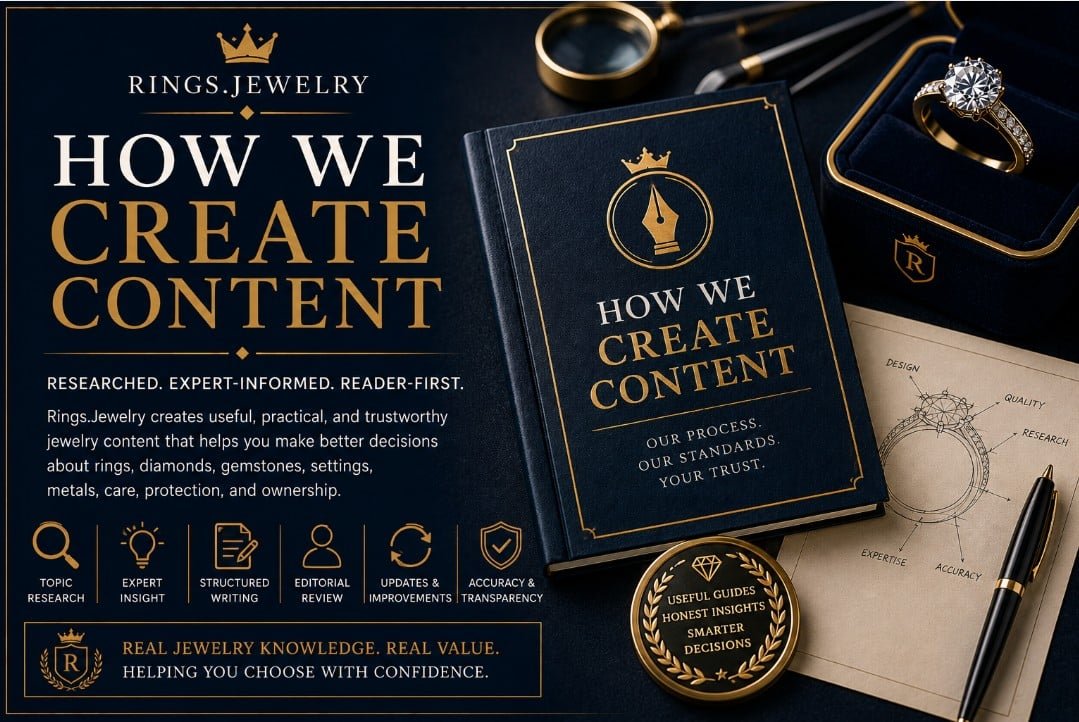
Rings.Jewelry creates jewelry education content for readers who want clearer, more practical guidance before making decisions about rings, diamonds, gemstones, settings, metals, repairs, appraisals, insurance, resale, and long-term ownership.
This page explains how we choose topics, structure articles, use expert-informed reasoning, review content, update pages, handle corrections, and keep reader trust at the center of the content process.
Our content is built to answer real jewelry questions, not fill pages with empty luxury language.
Every useful Rings.Jewelry guide should help a reader understand trade-offs, avoid mistakes, compare choices, and know when professional evaluation matters.
Why We Create Jewelry Content
Rings.Jewelry exists to make jewelry decisions easier to understand. A ring can be romantic, symbolic, expensive, technical, fragile, durable, sentimental, or all of those things at once. Our content helps readers see the practical side behind the sparkle.
We write for people who want to choose wisely, ask better questions, compare options, protect valuable pieces, understand trade-offs, and avoid common mistakes before buying, repairing, insuring, selling, or caring for jewelry.
How We Choose Topics
We choose topics based on reader usefulness, jewelry relevance, search intent, practical decision-making, and long-term educational value. We do not want unrelated content that weakens the site’s jewelry authority.
Buyer Questions
Topics that help readers compare rings, diamond shapes, settings, metals, budgets, documents, warranties, and buying risks.
Ownership Questions
Care, cleaning, repairs, resizing, insurance, appraisal documents, storage, travel, resale, and lost ring recovery topics.
Comparison Topics
Prong vs bezel, platinum vs white gold, lab-grown vs natural diamonds, 14k vs 18k gold, pavé vs channel, and similar decisions.
Risk and Mistakes
Content that explains what can go wrong: loose stones, weak prongs, poor documentation, unclear insurance, unrealistic resale expectations.
Expert Explainers
Guides that translate jewelry terminology, workshop logic, appraisal context, repair warnings, and material differences into plain language.
Trust Pages
Editorial policy, review policy, corrections, disclaimer, privacy, terms, advertising, and contributor standards that support transparency.
Our Content Creation Process
Not every page follows the exact same path, but strong Rings.Jewelry content usually moves through the same editorial logic: define the question, understand the jewelry decision, explain the trade-offs, organize the answer clearly, and review for practical usefulness.
- 1. Identify the reader question: we start with what the reader actually needs to understand, compare, avoid, protect, or decide.
- 2. Define the jewelry context: we consider materials, settings, stones, construction, care, repair, insurance, resale, or ownership details relevant to the topic.
- 3. Explain the practical answer: we try to give a clear answer early, then explain when the answer changes depending on lifestyle, budget, condition, or professional evaluation.
- 4. Add trade-offs: we avoid pretending one choice is perfect for everyone. Jewelry decisions usually involve beauty, durability, comfort, maintenance, cost, and risk.
- 5. Structure for readers: we use headings, comparison blocks, lists, checklists, examples, FAQ, and internal links so readers can find useful information quickly.
- 6. Review for clarity: we look for unclear claims, missing limitations, vague luxury language, and places where practical context would help.
Expert-Informed Jewelry Logic
Rings.Jewelry content is shaped by the professional perspectives that matter in jewelry: design, setting construction, gemstone knowledge, metal behavior, repair risk, appraisal documentation, insurance questions, resale realities, and daily wear.
We do not invent fake expert identities or fake credentials. Instead, we focus on the kind of practical questions a jeweler, gemologist, appraiser, repair specialist, insurer, designer, or resale advisor would naturally ask.
Example of expert-informed thinking
A ring is not judged only by how beautiful it looks in a photo. A practical content review also asks: Is the setting secure? Is the band too thin? Will it catch? Can it be resized? Does the stone need special care? Is documentation clear? Will maintenance be realistic for daily wear?
How We Structure Articles
Our articles are built to be readable for humans and understandable for search engines and AI answer systems. That means clear headings, direct answers, precise jewelry entities, and useful explanations that match the topic.
Quick Answer
When appropriate, we answer the main question early so readers do not have to dig through the page for the basic conclusion.
Comparison Logic
We explain how choices differ by sparkle, security, comfort, maintenance, price, durability, documentation, and ownership needs.
Practical Examples
We use real decision contexts: daily wear, active lifestyle, delicate designs, pre-owned rings, insurance preparation, or repair warnings.
Reader Checklists
Where useful, we include questions to ask before buying, selling, insuring, resizing, repairing, or choosing a ring style.
Research and Content Inputs
Rings.Jewelry content may draw on jewelry terminology, professional concepts, industry practices, product details, documentation standards, reader questions, brand information, and editorial review. The goal is not to overwhelm readers with jargon, but to make important details understandable.
- Jewelry terminology: prongs, bezels, pavé, cathedral, shank, gallery, rhodium plating, platinum, diamond cut, clarity, appraisal, and more.
- Real ownership context: cleaning, repair, resizing, insurance, storage, travel, resale, documentation, and lost ring prevention.
- Buyer questions: what matters before purchase, what documents to request, what trade-offs to expect, and when to ask a professional.
- Brand and product details: when relevant, we may consider product specifications, policies, documentation, service details, and materials provided by brands.
- Correction and feedback signals: reader questions and correction requests may help us improve, clarify, or expand content.
How We Think About AI Search and Search Clarity
Rings.Jewelry content is written for people first, but clear structure also helps search engines and AI answer systems understand the page. We want our content to be easy to interpret because jewelry topics often involve many related entities, trade-offs, and limitations.
We try to make pages clear with
- specific jewelry terminology;
- direct answers to common questions;
- well-organized headings;
- comparison logic;
- FAQ sections;
- internal links to related guides.
We avoid content that feels like
- generic filler;
- empty luxury wording;
- keyword stuffing;
- fake expertise;
- unrelated lifestyle content;
- thin pages with no reader value.
Review, Updates, and Corrections
Jewelry information can change. Product details, insurance practices, brand policies, market conditions, repair methods, and reader needs may evolve. Rings.Jewelry may update content to improve clarity, accuracy, usefulness, or structure.
Editorial Review
We review content for clarity, reader usefulness, practical context, jewelry relevance, and whether claims need stronger limitations.
Content Updates
We may update pages when information changes, examples need improvement, FAQ should be expanded, or internal links can help readers.
Corrections
Readers and professionals can report outdated information, unclear wording, factual issues, broken links, or missing context.
Disclosure
Sponsored, collaborative, affiliate, or product-sample relationships may be disclosed where appropriate.
Corrections help improve trust
To report an issue, visit our Corrections Policy or contact info@rings.jewelry.
Transparency and Limitations
Rings.Jewelry provides educational content. We do not appraise individual jewelry online, guarantee resale value, guarantee insurance outcomes, diagnose repairs from a distance, or replace professional evaluation.
- Educational only: our content helps readers learn, compare, and prepare better questions.
- No individual appraisal: specific jewelry value requires professional inspection, documentation, and context.
- No repair diagnosis: stone security, prong wear, metal fatigue, and resizing risk should be checked by a qualified jeweler.
- No insurance guarantee: coverage depends on policy language, insurer requirements, exclusions, and claim details.
- No fake authority: we do not invent fake experts, fake credentials, fake certifications, or fake review testing.
- Reader trust first: content should help readers make better-informed jewelry decisions.
Questions About How We Create Content?
For editorial questions, corrections, expert contribution ideas, sponsored content inquiries, review requests, or partnership opportunities, contact Rings.Jewelry directly.
Email: info@rings.jewelry
FAQ
How does Rings.Jewelry create content?
Rings.Jewelry creates content by identifying real jewelry questions, defining the practical decision, explaining trade-offs, using jewelry terminology clearly, reviewing for usefulness, and updating pages when needed.
Is Rings.Jewelry content expert-informed?
Yes. Rings.Jewelry content is shaped by expert-informed jewelry logic, including design, setting construction, gemstones, metals, repair risk, appraisals, insurance, resale, and ownership considerations.
Does Rings.Jewelry invent fake experts?
No. Rings.Jewelry does not invent fake expert names, fake credentials, fake certifications, or fake review testing. The site focuses on practical jewelry knowledge and transparent editorial standards.
Does Rings.Jewelry write for AI search?
Rings.Jewelry writes for human readers first, while using clear structure, specific jewelry terminology, direct answers, comparison logic, FAQ, and internal links so search engines and AI answer systems can understand the content.
How does Rings.Jewelry choose topics?
Rings.Jewelry chooses topics based on reader usefulness, jewelry relevance, search intent, practical decision-making, comparison value, ownership questions, and long-term educational importance.
Does Rings.Jewelry update old content?
Yes. Rings.Jewelry may update content when product details, market conditions, insurance practices, repair methods, brand policies, or reader needs change.
Can readers report corrections?
Yes. Readers and professionals can report factual issues, outdated information, unclear wording, broken links, or missing context through the Rings.Jewelry Corrections Policy or by emailing info@rings.jewelry.
Is Rings.Jewelry a substitute for professional evaluation?
No. Rings.Jewelry provides educational content and does not replace professional appraisal, repair inspection, insurance advice, gemological testing, or legal and financial advice.