Diamond Table and Depth Explained: Why Proportions Matter in Engagement Rings
Diamond table and depth sound like the boring part of engagement ring shopping until they quietly cost you money. They are not as romantic as carat size, not as sparkly-sounding as cut quality, and not as emotionally satisfying as saying “two carats” with confidence.
But table and depth are where a diamond reveals whether its weight is working for you or hiding in the wrong places.
A diamond can have a beautiful carat weight on paper and still look smaller, darker, flatter, or less lively than another diamond with the same weight. Why? Because proportions decide how the diamond handles light and how much of that weight appears from the top. Table size, total depth, crown height, pavilion depth, girdle thickness, and overall shape all work together to create the face-up look.
This is the blueprint-room guide: not a cold geometry lesson, but a jeweler’s explanation of how proportions change sparkle, spread, size, price, and the final look of an engagement ring.
The Proportion Answer Before the Numbers Start Looking Like Homework
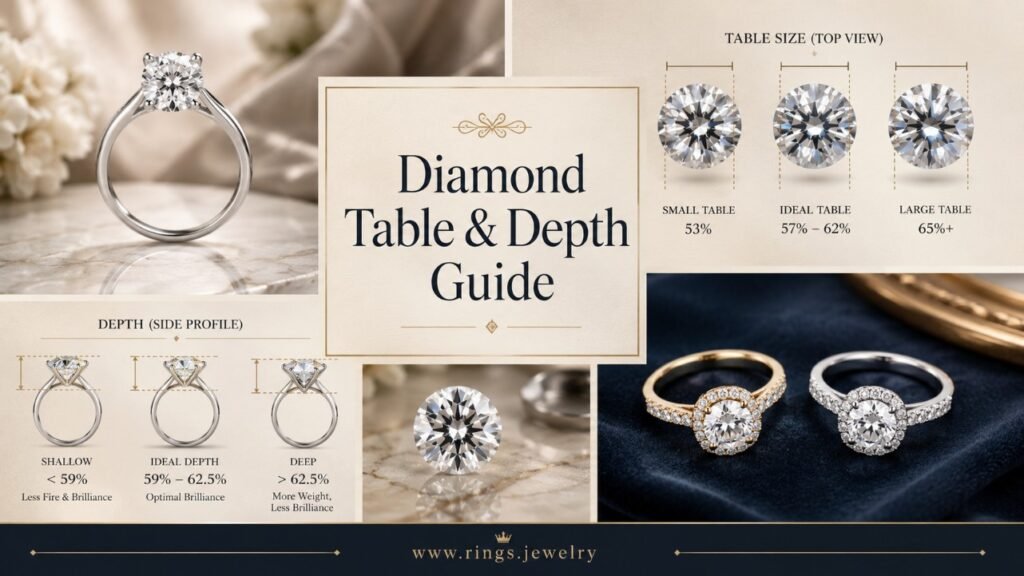
Diamond table and depth matter because they affect how large, bright, and balanced a diamond looks in an engagement ring. The table is the flat top facet of the diamond, usually shown as a percentage. Depth is the diamond’s total height from top to bottom, also shown as a percentage. If the table is too large, too small, or the depth is poorly balanced, the diamond may lose sparkle, look smaller for its carat weight, or appear less elegant. Good proportions do not guarantee a perfect diamond, but bad proportions often explain why a diamond looks disappointing despite good grades.
What Diamond Table Means Without Making It Weird
The table is the large flat facet on the top of a diamond. It is the “window” you look through when you see the diamond from above. On a grading report, table size is usually listed as a percentage of the diamond’s average width.
A larger table is not automatically better. A smaller table is not automatically more refined. The table has to work with the crown, pavilion, depth, angles, and shape. This is where the diamond stops being a number and starts becoming architecture.
The table is not a dinner plate
A big table can give a diamond a broad, glassy look if the rest of the proportions do not support it. A smaller table can create more fire in some designs, but it can also look cramped if the diamond is not balanced. The table needs context.
For round brilliant diamonds, table percentage is especially useful because the shape has more standardized expectations. With fancy shapes, table percentage still matters, but the outline, facet pattern, length-to-width ratio, bow-tie effect, and visual performance become just as important.
When comparing diamonds online, do not stare at table percentage like it is a magic password. Use it as one clue. Then look at the actual diamond, its video, its measurements, and how it returns light.
Depth: Where Diamond Weight Can Help or Hide
Depth is the diamond’s height from the table down to the culet, shown as a percentage of its width. In plain language: depth tells you how much of the diamond’s weight is sitting vertically.
This matters because carat is weight. A diamond can be heavier because it is deeper, not because it looks meaningfully larger from the top. That is the expensive trick nobody wants to discover after buying.
If the diamond is too deep, it may face up smaller than expected. If it is too shallow, it may spread wider but lose light performance. A shallow diamond can look large but weak. A deep diamond can look heavy but underwhelming. Neither is the luxury ending we want.
The hidden weight problem
Extra depth can make a diamond cost more without giving the eye more beauty. You may be paying for weight that sits underneath the stone instead of visible presence across the finger.
This is why measurements should always be reviewed with carat weight. A diamond’s length, width, and depth tell the real story. If two diamonds both weigh 1.50 carats, the one with better face-up measurements and stronger light return may be the better ring, even if the certificate summary looks similar.
Spread: The Word Buyers Should Learn Before Chasing Carat
Spread means how large the diamond appears from the top compared with its carat weight. A diamond with good spread gives you satisfying visible size without hiding too much weight in depth.
Spread is not everything. A diamond can have wide spread and still look flat or dull if it is too shallow. But when spread and light performance work together, the diamond feels smart: good size, good brightness, good value, no drama.
Face-up size is what the hand sees
The finger does not care how much weight is buried underneath the diamond. The eye reads the top view, the outline, the sparkle, and the balance with the setting.
This is especially important around popular carat milestones. A well-proportioned 1.40-carat diamond may look almost as satisfying as a poorly proportioned 1.50-carat stone. A strong 1.90-carat diamond may feel very close to 2 carats visually. The number matters, but the measurements tell you whether the number is doing useful work.
If visible size is part of your buying decision, our diamond carat size and visible size guide explains how weight, spread, hand proportion, and setting design work together.
Table and Depth Affect How the Diamond Handles Light
Diamond beauty is not only about size. It is about what happens when light enters the stone. Good proportions help light return through the top of the diamond. Weak proportions may allow light to leak away, making the diamond look darker, glassier, or less lively.
A diamond with a poorly balanced table and depth may still flash under jewelry store lighting, because jewelry store lighting is paid to flatter. But in real life — daylight, office light, restaurant light, bathroom mirror light, the unforgiving light near a kitchen sink — proportions begin telling the truth.
The sparkle problem is often structural
If a diamond looks sleepy, dull, watery, or dark in the center, the issue may not be color or clarity. It may be proportions and cut quality.
Table and depth do not work alone. Crown angle, pavilion angle, lower girdle facets, polish, symmetry, and facet precision all matter. But table and depth are often the first report numbers that help explain why two diamonds with similar carat, color, and clarity can look completely different.
For the full light-performance conversation, read our guide to diamond cut quality and sparkle.
Round Brilliant Diamonds: Where Table and Depth Are Easier to Judge
Round brilliant diamonds are the most standardized shape for cut analysis. That makes table and depth especially useful when comparing stones. You can look at the report, review the measurements, check the cut grade, and then confirm visually whether the diamond performs well.
For round diamonds, table and depth should support brightness, fire, contrast, and spread. If the table is too large, the diamond may look flatter or less fiery. If the depth is too high, it may face up smaller. If it is too shallow, it may lose brightness or show leakage.
For round diamonds, compare these together
- Table percentage: one clue about the top facet and light behavior.
- Depth percentage: shows whether weight may be hiding vertically.
- Diameter: helps reveal visible spread for the carat weight.
- Cut grade: important, but still not a substitute for looking at the stone.
- Video or real-life view: confirms whether the diamond actually looks alive.
A strong round diamond should not need excuses. It should look bright, balanced, and pleasing from the top. If the report looks acceptable but the diamond does not excite the eye, keep comparing.
Fancy Shapes: The Numbers Help, But the Outline Has Opinions
Fancy shapes are less obedient than round diamonds. Oval, emerald, cushion, pear, marquise, radiant, princess, and asscher diamonds all use table and depth differently. A table percentage that looks reasonable in one shape may not tell the same story in another.
This is where buyers need to stop hunting for one perfect number and start evaluating the full shape.
Oval
Check length-to-width ratio, bow-tie effect, center brightness, and whether the diamond looks graceful or stretched.
Emerald Cut
Depth and table influence the step pattern, but clarity, symmetry, and hall-of-mirrors reflection matter heavily.
Cushion
Some cushions face up smaller because they hold weight deeper. Compare actual measurements, not only carat.
Pear and Marquise
Look at outline balance, tip protection, bow-tie, and whether the stone gives elegant finger coverage.
Fancy shapes are personal. They can be very smart for visible size, especially elongated shapes, but they also require more visual judgment. A report can guide you; it cannot tell you whether an oval has awkward shoulders or an emerald cut looks dead in the middle.
If you are still comparing outlines, our diamond shape guide for engagement rings walks through the style, sparkle, clarity, and setting differences between popular shapes.
When a Diamond Is Too Deep: The “Expensive but Smaller” Problem
A deep diamond can be frustrating because it may look like a good purchase until you compare it beside a better-proportioned stone. The carat weight sounds impressive. The price may reflect that weight. But from above, the diamond can look smaller than expected.
This happens because some of the diamond’s weight is sitting in the pavilion instead of spreading across the top. In simple terms: you paid for diamond that the eye does not fully get to enjoy.
Signs the diamond may be too deep
- It faces up smaller than other diamonds of the same carat weight.
- The diameter or measurements feel underwhelming for the price.
- The center looks dark or less lively.
- The stone appears heavy rather than bright.
- A slightly lighter diamond looks visually larger beside it.
Deep diamonds are not automatically bad in every shape, because fancy shapes have different proportion ranges. But if a diamond is deep and also lacks sparkle or spread, that is not a charming quirk. That is a buying problem.
When a Diamond Is Too Shallow: The “Big but Weak” Problem
A shallow diamond may look tempting because it can spread wider for its weight. The face-up size may appear generous. The price may feel clever. Then the light performance says, “Not so fast.”
If the diamond is too shallow, light can leak instead of returning cleanly through the top. The stone may look watery, flat, glassy, or strangely transparent. It can have size without presence.
Signs the diamond may be too shallow
- It looks wide but lacks depth of sparkle.
- The center appears washed out or watery.
- The diamond has poor contrast.
- It looks less expensive than its size suggests.
- It performs badly outside strong showroom lighting.
This is why spread alone is not enough. A diamond should not only look large; it should look alive. If the stone spreads beautifully but forgets to sparkle, keep shopping.
How to Read Table and Depth on a Diamond Report
A diamond report usually lists table percentage, depth percentage, dimensions, cut grade for round diamonds, polish, symmetry, fluorescence, color, clarity, and comments. The table and depth lines are useful, but they should be read with the measurements.
Start with carat weight. Then check the measurements. Then look at depth. Then table. Then cut grade or shape-specific visual evidence. This order keeps you from worshipping one number and missing the full diamond.
The report reading sequence
- Carat weight: tells you weight, not visual size.
- Measurements: show face-up length and width.
- Depth percentage: helps explain whether weight is hidden vertically.
- Table percentage: gives context for the top facet and light behavior.
- Cut / polish / symmetry: support overall finish and performance.
- Video or inspection: confirms whether the diamond actually looks beautiful.
Certification gives you the data. Judgment turns that data into a good ring. If you want help understanding report sources and grading language, read our guide to GIA, IGI, and GCAL diamond grading reports.
The Final Table and Depth Check Before You Buy
Diamond table and depth are not glamorous terms, but they protect you from one of the most common buying mistakes: paying for a diamond that looks better on paper than on the hand.
Good proportions help a diamond look bright, balanced, and properly sized for its carat weight. Poor proportions can make a stone look smaller, darker, flatter, or less luxurious than its grades suggest.
Do not choose a diamond from table and depth alone. Choose it from the full blueprint: measurements, cut quality, shape, spread, light return, clarity, color, setting design, and real-life appearance. A diamond is not a spreadsheet. It is a tiny piece of architecture that has to perform every time the hand moves.
The right proportions do not just make the diamond technically better. They make the ring feel more expensive, more intentional, and more satisfying long after the certificate is filed away.
FAQ
What is diamond table?
Diamond table is the flat top facet of a diamond. On a report, it is usually shown as a percentage of the diamond’s width.
What is diamond depth?
Diamond depth is the total height of the diamond from top to bottom. It is usually shown as a percentage and helps explain how the diamond carries its weight.
Why do diamond table and depth matter?
They affect how the diamond handles light and how large it appears from above. Poor table and depth balance can make a diamond look dull, dark, flat, or smaller than expected.
Is a bigger diamond table better?
Not automatically. A larger table can sometimes make a diamond look broader, but if it is not balanced with crown and pavilion proportions, the diamond may lose fire or look glassy.
Can a diamond be too deep?
Yes. A diamond that is too deep may carry extra weight underneath, making it face up smaller than other diamonds with the same carat weight.
Can a diamond be too shallow?
Yes. A shallow diamond may look wide for its weight, but it can lose brightness, contrast, and depth of sparkle if the proportions are weak.
Do table and depth matter for fancy shape diamonds?
They matter, but they are not enough by themselves. Fancy shapes also need visual review for outline, bow-tie effect, facet pattern, length-to-width ratio, and overall beauty.
How do table and depth affect carat size?
A diamond with too much depth may weigh more without looking larger. A well-proportioned diamond can give better visible size for its carat weight.
Should I buy a diamond based only on ideal table and depth numbers?
No. Table and depth are useful, but they should be judged with measurements, cut quality, video, shape, symmetry, clarity, color, and real-life appearance.
Where can I find table and depth on a diamond report?
Most diamond grading reports list table percentage, depth percentage, and measurements in the proportion or diamond details section.