
Engagement Ring Trends 2026: What’s Popular Right Now
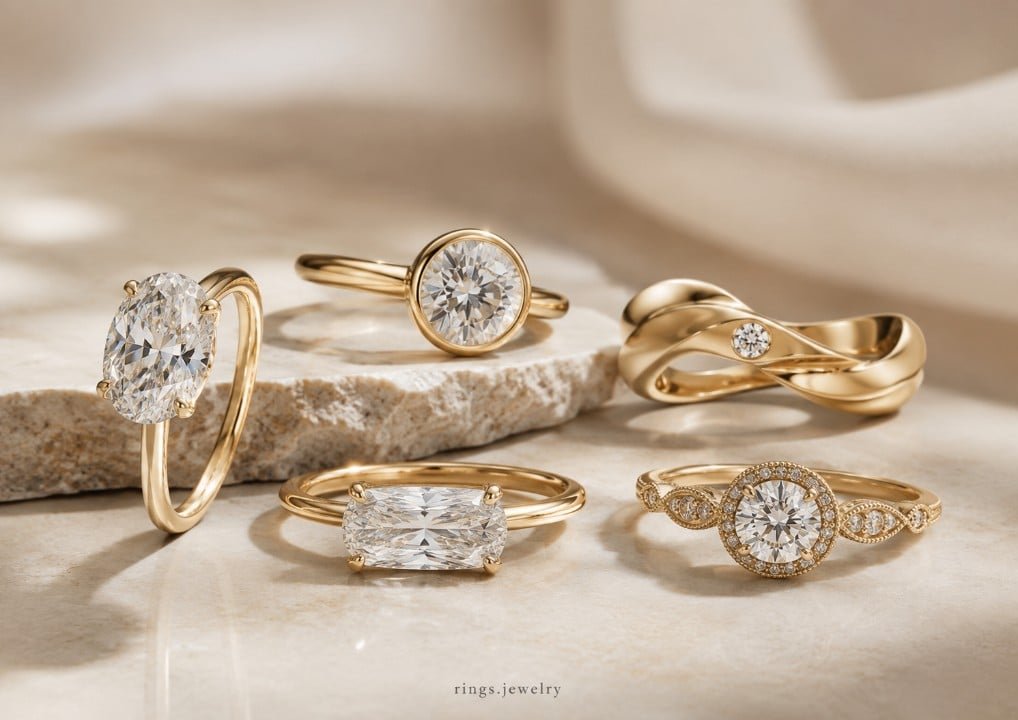
Engagement rings in 2026 are becoming more personal, more architectural, and much more interesting than the predictable “big diamond on a thin band” formula that dominated bridal jewelry for years.
A beautiful classic solitaire will always have its place. I would never argue against a perfectly proportioned round brilliant in a well-made setting; that kind of ring does not need a trend report to defend itself. But the conversation around engagement rings has changed. Clients now ask sharper questions: Should we choose a lab-grown diamond or natural? Is yellow gold really back? Will a bezel setting protect the stone better? Does an oval diamond actually look larger? Can a vintage-inspired ring be durable enough for daily wear?
These are the right questions. A serious engagement ring is not only a romantic object; it is a small piece of engineering, sculpture, gemology, and daily life all compressed into one very emotional purchase. It has to sparkle under dinner lights, survive winter gloves, sit comfortably beside a wedding band, and still feel meaningful after the proposal photo has become a framed memory.
In our workshop, the strongest 2026 engagement ring trends are not just about fashion. They are about better choices: better stones, smarter settings, warmer metals, stronger silhouettes, and personal details that feel intimate rather than decorative for decoration’s sake. The best rings this year look less like algorithm jewelry and more like something chosen by a person with taste.
Quick Answer: What Engagement Ring Trends Are Popular in 2026?
The strongest engagement ring trends in 2026 are lab-grown diamonds, oval and elongated diamond shapes, east-west settings, bezel engagement rings, yellow gold, sculptural bands, hidden halos, personalized details, gemstone engagement rings, and vintage-inspired designs.
The bigger shift is not one single style. It is the move toward rings that feel individual, well-crafted, wearable, and emotionally specific. Buyers still want beauty, of course. But they also want proportion, durability, meaning, comfort, and a design that will not look tired after one season of social media attention.
Lab-Grown Diamonds Are Now Mainstream
Lab-grown diamonds are no longer the awkward guest at the engagement ring dinner party. They are no longer being introduced with a nervous explanation or treated as a compromise for people who could not reach a natural diamond budget. In 2026, lab-grown diamonds are part of the main engagement ring conversation, and many buyers now ask about them before they ask about natural stones.
The appeal is obvious. Lab-grown diamonds allow many couples to choose a larger carat weight, higher color grade, better clarity, or more refined setting without pushing the budget into uncomfortable territory. A buyer who once had to choose between size and quality may now have room for both. That changes the design conversation in a meaningful way.
From a gemological point of view, a lab-grown diamond is still a diamond. It has the same crystal structure and essential optical behavior as a natural diamond. The difference is origin. One formed underground over geological time; the other was grown in a controlled laboratory environment. For some people, natural origin carries emotional and rarity value. For others, the visible beauty, certification, price, and modern practicality matter more.
What matters most is not whether the diamond is lab-grown or natural, but whether it is beautiful. I would rather see a well-cut lab-grown diamond in a properly engineered setting than a natural diamond with lifeless proportions mounted in a weak commercial ring. Nature gives romance, yes. But cut quality gives performance.
This is where many buyers make a mistake. They see that lab-grown diamonds are more affordable and immediately chase the largest stone available. Bigger can be wonderful, but only if the diamond has strong light return, clean proportions, good symmetry, and a setting that can physically support it. A large dull diamond is still dull; it simply gives you more dullness for the money.
Jeweler’s Note
The setting does not care whether a diamond is natural or lab-grown. The prongs, basket, gallery rail, stone seat, and shank care about millimeter accuracy, metal strength, and clean finishing. A diamond can have excellent paperwork and still be poorly protected if the ring is badly made.
In the workshop, we look beyond the grading report. We examine how the diamond behaves under different lighting. We check whether the center goes dark. We look for uneven brightness, awkward reflections, windowing in step cuts, and bow-tie issues in elongated shapes. A diamond should not perform only under showroom spotlights, because showroom lighting is basically jewelry theater.
Lab-grown diamonds are especially strong for modern 2026 designs: oval solitaires in yellow gold, emerald cuts in bezels, elongated cushions with hidden halos, east-west settings, and three-stone rings where the budget allows better side stones. Instead of treating the savings as a way to buy only more carat weight, the smartest buyers use that flexibility to improve the whole ring.
Lab-Grown vs. Natural Diamonds: What Buyers Should Know
Lab-Grown Diamond
What it means: Created in a controlled laboratory environment.
Best for: Buyers who want diamond beauty, larger size, or higher specifications with more budget flexibility.
Jeweler’s advice: Treat it seriously, but still judge the individual stone carefully.
Natural Diamond
What it means: Formed underground over geological time.
Best for: Buyers who value rarity, tradition, natural origin, and long-standing emotional symbolism.
Jeweler’s advice: Do not pay for romance alone; cut quality still matters enormously.
More Size Flexibility
Lab-grown advantage: Often allows a larger diamond or higher grade for the same budget.
Smart use: Upgrade the setting, craftsmanship, or diamond cut instead of chasing only carat weight.
Emotion vs. Practical Value
Natural diamond: Often chosen for rarity and tradition.
Lab-grown diamond: Often chosen for modern value, transparency, and visual impact.
My practical recommendation is simple: if your priority is visible size, high specifications, and a more flexible budget, lab-grown diamonds deserve serious consideration. If natural origin, rarity, and traditional symbolism matter deeply to you, a natural diamond may feel more emotionally right. Neither choice is automatically superior. The wrong choice is buying a mediocre stone because the label sounds impressive.
Expert Verdict
Lab-grown diamonds are one of the most important engagement ring trends of 2026 because they have changed how couples think about value. The best purchases are not simply larger diamonds; they are better-balanced rings where the stone, setting, metal, and craftsmanship all work together.
Oval and Elongated Diamond Shapes
Oval diamonds continue to dominate because they offer exactly what many buyers want: elegance, finger coverage, softness, and a larger visual presence without always requiring a larger budget. A well-proportioned oval diamond can look more expansive on the hand than a round diamond of the same carat weight. That is not magic, but it does feel like it when the ring is photographed well.
The broader trend is not only oval. Pear shapes, marquise diamonds, elongated cushions, radiant cuts, and emerald cuts are all part of the same movement toward length, presence, and silhouette. These stones stretch visually across the finger, giving the ring a graceful line that many modern buyers find more flattering than a compact shape.
As a jeweler, I like elongated diamonds because they make design more interesting. A round brilliant is forgiving in many settings. An elongated stone asks more from the ring. The prongs need to be placed correctly. The basket must support the stone. The band width should match the scale. The diamond’s outline becomes part of the entire composition.
But elongated does not automatically mean better. A pear shape can be elegant or awkward depending on shoulder symmetry and point protection. A marquise can look regal or theatrical depending on proportion. An emerald cut can look quietly luxurious or strangely flat depending on clarity and facet life. An oval can look beautifully balanced, or it can look like a stretched egg with lighting issues. Jewelry is kind, but not that kind.
The most famous technical issue with oval, pear, marquise, and some elongated cushion diamonds is the bow-tie effect. This is the darker area that can appear across the center of the stone. A slight bow-tie is normal. A heavy bow-tie that makes the diamond look dead through the middle is not something I would recommend, even if the price is charming.
Workshop Note
When we inspect an oval diamond, we rotate it under different lighting instead of judging it only under showroom lights. We look for brightness across the center, balanced shoulders, a pleasing outline, and a length-to-width ratio that suits the wearer’s hand.
Length-to-width ratio is one of the quiet details that changes everything. A shorter oval feels softer and more classic. A longer oval feels more elegant and dramatic. A slightly fuller pear can feel romantic, while a sharper pear feels more fashion-forward. A slender marquise can elongate the finger beautifully, but it needs confidence and the right setting.
Emerald cuts belong in this conversation, but their beauty is different. They are step-cut stones, which means they do not produce the same glittery sparkle as round brilliant or oval diamonds. Instead, they create long flashes of light and a mirror-like calm. An emerald cut engagement ring does not beg for attention. It assumes attention will arrive eventually, and it is usually correct.
Elongated Diamond Shapes: Best For Different Styles
Oval Diamond
Best for: Buyers who want a flattering shape with graceful sparkle.
Watch for: Bow-tie effect, uneven outline, and poor length-to-width ratio.
Emerald Cut
Best for: Minimalists, architectural style, and buyers who love clean lines.
Watch for: Visible inclusions, windowing, and weak step-cut performance.
Pear Diamond
Best for: A feminine, graceful, slightly dramatic engagement ring.
Watch for: Uneven shoulders and an unprotected point.
Marquise Diamond
Best for: Maximum finger elongation and a bold, historic silhouette.
Watch for: Tip protection, bow-tie effect, and overly narrow proportions.
Oval diamonds work beautifully with many 2026 trends. They look warm in yellow gold, secure in bezel settings, romantic with hidden halos, classic in solitaire designs, and surprisingly modern when set east-west. That flexibility is why the oval remains so powerful. It can be styled for almost any personality without losing its softness.
If you are choosing an elongated diamond, do not buy from numbers alone. Two stones with the same carat weight, color, and clarity can look completely different in real life. One may spread beautifully and glow across the center. Another may look narrow, dark, or awkward. The certificate is a map; it is not the destination.
Expert Verdict
Oval and elongated diamond shapes are popular in 2026 because they combine visual impact with elegance. The best choice depends on proportion, bow-tie control, setting design, and how the stone looks on the actual hand, not only in a product photo.
East-West Settings
An east-west setting places the center stone horizontally across the finger rather than vertically along it. It sounds like a small adjustment, but orientation changes the entire personality of a ring. A vertical oval feels bridal and romantic. A horizontal oval feels modern, relaxed, and a little more editorial.
This trend is popular because it refreshes familiar diamond shapes without making them unrecognizable. An emerald cut becomes more architectural. A marquise becomes less traditional and more fashion-conscious. An oval becomes clean and unexpected. A radiant cut becomes bolder and more graphic.
East-west engagement rings are especially appealing to buyers who want something distinctive but still wearable. They are modern without being strange. They feel stylish without depending on too much decoration. A good east-west ring has the kind of confidence that does not need a chorus of tiny accent stones to explain itself.
From the bench side, east-west settings need careful planning. The center stone spreads across the shank, which changes the visual balance and the physical support. The setting must protect the ends of elongated stones, especially marquise, pear, and emerald-cut diamonds. If the ring is too wide for the hand or too flat in profile, it can look awkward instead of elegant.
A good east-west engagement ring does not look like it is trying to be different. It simply looks like the wearer has excellent taste and no need to ask permission.
The best stones for east-west settings usually have a strong outline. Emerald cuts are excellent because their geometry becomes the entire design statement. Marquise diamonds feel fresh again when rotated horizontally. Ovals look soft and modern. Elongated cushions bring a warmer, slightly romantic interpretation of the trend.
East-west settings also pair beautifully with bezels. The bezel outlines the stone, protects the edge, and creates a sleek modern frame. This combination often feels more like fine design than traditional bridal jewelry, which is exactly why many style-focused buyers love it.
East-West Settings: When They Work Best
Elongated Stones
Ideal options: Oval, emerald cut, marquise, radiant, and elongated cushion.
Why it works: The horizontal orientation emphasizes the stone’s length and creates a modern silhouette.
Modern Minimalism
Ideal wearer: Someone who likes clean lines, tailored fashion, and jewelry that feels intentional.
Why it works: The setting feels distinctive without becoming overly decorative.
Bezel or Secure Prongs
Ideal construction: A protective bezel or carefully placed prongs at vulnerable stone edges.
Why it matters: Elongated stones need proper support, especially at tips and corners.
Finger Proportion
Watch for: A stone that spreads too wide across narrow fingers.
Jeweler’s advice: Always consider ring size, stone dimensions, and hand shape together.
East-west settings are not for everyone. If the wearer dreams of a traditional ring that looks unmistakably classic from across the room, this trend may feel too modern. But if they love design, architecture, minimalist fashion, or jewelry that feels quietly unconventional, an east-west setting can be an excellent choice.
Workshop Note
With east-west rings, we check visual centering as carefully as mathematical centering. Some elongated stones have tiny outline irregularities, especially antique-style cuts. A skilled setter adjusts for what the eye sees, not only what the caliper measures.
Bezel Engagement Rings
Bezel engagement rings are having a very elegant comeback. A bezel setting surrounds the edge of the center stone with a slim rim of metal instead of holding it only with prongs. It is one of the oldest ways to set gemstones, but in 2026 it feels modern, refined, and refreshingly practical.
Part of the appeal is security. Engagement rings are not worn in display cases. They are worn while working, traveling, opening doors, carrying bags, holding children, taking off gloves, and occasionally doing things that would make a jeweler quietly stare into the distance. A bezel protects the edge of the stone better than many open prong settings.
The other appeal is style. A good bezel has a clean outline and a confident architectural presence. It can make a diamond look sleek and intentional. It can also make a colored gemstone feel more secure and complete. Poorly made bezels, however, can look heavy. The difference between modern luxury and metal tire around a diamond is often only a few millimeters.
The bezel lip matters. The metal should hold the stone securely without swallowing it. The edge should be even, smooth, and well-polished. The stone seat must be cut accurately so the gem sits level. If the bezel looks wavy or bulky from the side, the ring may not have the refined finishing expected from a serious engagement piece.
Bezel vs. Prong Settings
Bezel Setting
Strength: Excellent edge protection for the center stone.
Best for: Active wearers, low-profile designs, gemstones, and modern rings.
Watch for: A bezel that is too thick or poorly finished.
Prong Setting
Strength: Open, airy, traditional, and excellent for visible diamond presence.
Best for: Classic solitaires and buyers who want maximum exposure around the stone.
Watch for: Prongs need periodic checking because they can wear or catch over time.
Diamond Performance
Bezel: May reduce some side light depending on design, but a well-cut diamond still performs beautifully.
Prongs: Allow more open light exposure, especially in classic raised settings.
Practical Choice
Bezel: Smoother and less likely to catch on clothing.
Prongs: More traditional but may require more maintenance over years of wear.
Bezel settings are especially strong with oval, emerald-cut, round, marquise, and east-west diamonds. They also work beautifully with colored gemstones because many gemstones benefit from additional edge protection. An emerald, for example, is gorgeous but more delicate than diamond or sapphire. A bezel can help protect it, though it does not magically turn emerald into industrial equipment.
Another factor is wedding band fit. Some bezel engagement rings sit low and close to the finger, which is comfortable for daily wear but may require a curved, contoured, or custom wedding band. That is not a flaw. It simply needs to be planned before the wedding band shopping begins.
Master Jeweler’s Tip
Always look at a bezel ring from the side. The side profile reveals the quality of the setting. A refined bezel should look clean, balanced, and smooth. If it looks thick, uneven, or clumsy, the top view alone is not enough to save it.
My professional view is that bezel engagement rings are one of the smartest 2026 trends. They combine style with common sense. They are protective, comfortable, and visually strong. They may not satisfy someone who wants the most traditional prong-set solitaire, but for modern luxury, they are extremely persuasive.
Yellow Gold and Sculptural Bands
Yellow gold has returned with confidence, and it looks very pleased about it. After years of white gold and platinum dominating engagement ring displays, yellow gold now feels warm, expensive, and emotionally rich again. It brings softness to diamonds and gives modern rings a sense of heritage without making them feel old-fashioned.
This trend is not only about color. It is about the way gold is being used. The strongest yellow gold engagement rings in 2026 are sculptural, tactile, and intentional. Think softly rounded shanks, wider bands, cigar-band profiles, cathedral shoulders, bezel frames, and settings where the metal is part of the design rather than merely a support system for the diamond.
Yellow gold pairs beautifully with oval diamonds, old mine cuts, emerald cuts, champagne diamonds, yellow diamonds, and vintage-inspired settings. It also flatters many skin tones and gives the ring a warmer emotional temperature. White metals can feel crisp and icy. Yellow gold feels human.
The practical question is usually 14k versus 18k. 18k yellow gold has a richer, deeper color because it contains more pure gold. 14k yellow gold is slightly more resistant to wear because it contains more alloy metals. Both can be excellent choices. The right answer depends on lifestyle, design structure, color preference, and how delicate the ring is.
14k vs. 18k Yellow Gold for Engagement Rings
14k Yellow Gold
Best for: Daily wear, active lifestyles, and more delicate ring structures.
Look: Warm gold tone, usually slightly softer in color than 18k.
Jeweler’s advice: A very practical choice for engagement rings worn every day.
18k Yellow Gold
Best for: Richer color, heirloom-inspired designs, and luxury settings.
Look: Deeper, more saturated gold tone.
Jeweler’s advice: Beautiful, but slightly softer than 14k and best with thoughtful construction.
Sculptural Bands
Best for: Buyers who want presence, structure, and a more expensive visual feel.
Why it matters: A stronger shank can support larger stones better than ultra-thin bands.
Ultra-Thin Bands
Problem: Very thin shanks can bend, twist, or weaken over time.
Jeweler’s advice: Delicate is beautiful; underbuilt is not. Those are different things.
Sculptural bands are rising partly because buyers are becoming more realistic. Ultra-thin bands became popular because they made center stones look larger and photographed beautifully. But in real life, very thin shanks can bend, distort, or create problems with pavé. When a large diamond is placed on a fragile band, the ring may look romantic on day one and exhausted after a few years.
A well-designed band should support the center stone visually and physically. Cathedral shoulders can add height and elegance. A wider shank can feel luxurious and stable. A rounded gold band can make the ring more comfortable. A cigar band can make even a simple center stone feel fashion-forward and substantial.
Workshop Note
When a client wants a very large center stone on a very thin band, we always discuss structure. Metal has limits. A ring can look delicate without being dangerously weak, but that requires proportion, not wishful thinking.
Yellow gold and sculptural bands work especially well together because the metal becomes part of the ring’s personality. A bezel-set oval in yellow gold can feel warm and modern. An emerald cut on a wider yellow gold band can feel powerful but restrained. A champagne diamond in yellow gold can look quietly expensive in a way that does not need applause.
Expert Verdict
Yellow gold is one of the most wearable luxury trends of 2026. Sculptural bands add visual richness and often improve long-term durability. Together, they create engagement rings that feel warmer, stronger, and more personal than many ultra-thin white-metal designs.
Hidden Halos and Personal Details
Hidden halos remain popular because they add sparkle without making the ring look overly decorative from the top. A hidden halo is usually a row of small diamonds placed beneath the center stone, around the basket or gallery. From above, the ring may appear close to a solitaire. From the side, it reveals a private flash of detail.
That private quality is exactly why buyers love it. A traditional halo announces itself immediately. A hidden halo is more discreet. It feels like the silk lining inside a tailored jacket: not everyone sees it, but the owner knows it is there. In luxury, the details meant for the wearer are often the most charming.
The broader trend is personalization. Couples want rings that include small emotional details: engraved dates, initials, meaningful symbols, birthstones, secret stones inside the band, custom galleries, family motifs, or design references to heirloom jewelry. The best personal details are not loud. They feel discovered.
However, personalization needs restraint. Too many symbolic elements can make a ring feel cluttered. A luxury engagement ring should not look like it is trying to carry an entire scrapbook on one finger. One beautifully executed detail is often more powerful than five ideas competing for attention.
Personal Details That Work Beautifully
Hidden Halo
Best for: Buyers who want extra brilliance without a full traditional halo.
Watch for: Pavé quality, secure bead work, and wedding band clearance.
Engraving
Best for: Dates, initials, short phrases, coordinates, or private words.
Watch for: Enough band width for clean, readable engraving.
Secret Birthstone
Best for: A hidden personal accent inside the band or gallery.
Watch for: Stone durability and placement away from heavy wear areas.
Custom Gallery
Best for: Symbolic motifs, heirloom references, or architectural side details.
Watch for: Complexity that weakens the setting or makes cleaning difficult.
Hidden halos require good craftsmanship. Tiny diamonds in pavé or micro-pavé are held by small beads of metal. If the work is careless, stones can loosen over time. If the gallery is too delicate, the ring may be difficult to maintain. If the hidden halo sits too close to the wedding band, friction can become an issue.
This is why I always recommend discussing the entire bridal set, not only the engagement ring. A hidden halo may be gorgeous, but it should not make the wedding band impossible to fit or cause the two rings to rub aggressively. Good design thinks ahead.
Important Pavé Warning
Tiny diamonds are not decoration glued onto the ring. They are small gemstones held by small amounts of metal. If the setting work is weak, pavé stones can loosen. With hidden halos, craftsmanship matters more than many buyers realize.
My favorite personal details are the ones that do not interrupt the main design. A hidden halo under an oval diamond. A small sapphire inside the band. A hand-engraved date. A custom gallery that only becomes visible from the side. These details make the ring feel intimate without reducing its elegance.
Master Jeweler’s Tip
Choose one emotional detail and execute it beautifully. A ring with one meaningful secret often feels more luxurious than a ring trying to explain an entire love story through every available surface.
Gemstone Engagement Rings
Gemstone engagement rings are becoming more prominent because buyers want color, symbolism, and individuality. Diamonds still dominate the engagement category, but sapphires, emeralds, rubies, champagne diamonds, yellow diamonds, and other colored stones are gaining serious attention. Color makes a ring feel personal immediately.
Blue sapphire is one of the strongest diamond alternatives because it is durable, elegant, and historically associated with loyalty and nobility. Emeralds bring romance, glamour, and a very old-world kind of beauty. Rubies are intense and dramatic. Champagne diamonds feel warm and understated. Yellow diamonds can look exceptional in yellow gold when the whole design embraces their color.
The important question is durability. Not every beautiful gemstone belongs in an everyday engagement ring. Engagement rings are worn constantly, and constant wear is demanding. A gemstone may be perfect for earrings or an occasional cocktail ring but risky for daily bridal jewelry.
Diamonds are famous for hardness, but hardness is not the whole story. Toughness, cleavage, inclusions, and setting protection also matter. Emeralds, for example, are loved for their glowing green color, but they often contain natural inclusions. Those inclusions give emeralds character, but they also make them more vulnerable than sapphires or diamonds.
Gemstones for Engagement Rings: Durability Guide
Diamond
Style impression: Classic, brilliant, durable, and highly versatile.
Daily wear: Excellent when properly set.
Jeweler’s advice: Still the safest choice for constant wear, especially for very active hands.
Sapphire
Style impression: Regal, elegant, meaningful, and sophisticated.
Daily wear: Excellent.
Jeweler’s advice: One of the best colored gemstones for engagement rings.
Ruby
Style impression: Passionate, dramatic, rich, and confident.
Daily wear: Very good when chosen and set properly.
Jeweler’s advice: Color quality and treatment disclosure matter greatly.
Emerald
Style impression: Romantic, vintage, glamorous, and deeply elegant.
Daily wear: Moderate; requires more care.
Jeweler’s advice: Beautiful but more delicate. Protective settings are wise.
Champagne Diamond
Style impression: Soft, warm, earthy, and modern.
Daily wear: Excellent.
Jeweler’s advice: Pairs beautifully with yellow gold and vintage-inspired settings.
Opal or Pearl
Style impression: Poetic, soft, delicate, and romantic.
Daily wear: Poor for most engagement rings.
Jeweler’s advice: Better for occasional jewelry than a ring worn every day.
Gemstone engagement rings need thoughtful settings. A sapphire can be magnificent in a three-stone ring with diamond side stones. An emerald often benefits from a bezel or protective prongs. A ruby can look extraordinary in yellow gold, but the exact shade matters. Champagne diamonds should not be treated like failed white diamonds; they should be celebrated for warmth.
Treatments also matter. Many sapphires and rubies are heat-treated, which is common in the industry. Emeralds are often treated with oils or resins to improve appearance. These treatments do not automatically make a stone bad, but they should be disclosed clearly. Luxury is not only beauty. Luxury is honesty, documentation, and confidence in what you are buying.
Historical Detail
Gemstone engagement rings are not a new rebellion against diamond tradition. Sapphires, rubies, and emeralds have long held symbolic power in royal, aristocratic, and high-jewelry contexts. Diamonds became the modern default through a mixture of marketing, availability, durability, and cultural habit.
Choose a gemstone engagement ring when the color truly means something or fits the wearer’s style. Do not choose one only to be different. Different is easy. Beautiful, durable, symbolic, and wearable is the real achievement.
Vintage-Inspired Rings
Vintage-inspired engagement rings are becoming more refined in 2026. The best versions are not costume copies of antique jewelry. They borrow the romance, hand-finished detail, and emotional softness of older pieces while using modern construction and durability.
This trend includes old mine cuts, old European cuts, antique-style cushions, milgrain edges, hand engraving, compass prongs, filigree details, bezel-set stones, and warm yellow gold. The appeal is not only visual. Vintage-inspired rings often feel as if they have a story, even when they were made recently.
Antique-style diamond cuts are especially important. Modern brilliant cuts are engineered for precision and maximum sparkle. Old mine and old European cuts often have larger facets, higher crowns, smaller tables, and a softer glow. They do not always behave like modern diamonds. They flicker. They breathe. They have personality.
That personality is exactly what many modern buyers want. After seeing thousands of nearly identical rings online, people are hungry for designs that feel less sterile. A vintage-inspired ring can feel romantic, literary, architectural, and deeply personal.
A modern brilliant diamond can look like a chandelier. An old mine cut can look like candlelight. Both can be beautiful, but they speak different languages.
The danger is over-decoration. Too much filigree, too much engraving, too many accent stones, and suddenly the ring starts to look theatrical rather than elegant. The best vintage-inspired designs are disciplined. A milgrain edge here. A hand-engraved shoulder there. A warm diamond in yellow gold. A basket with just enough detail to reward a closer look.
Craftsmanship is everything. Hand engraving should be clean and intentional. Milgrain should be even, not messy. Prongs should protect the stone without becoming bulky. If the details are poorly finished, the ring does not look romantic; it looks inexpensive with extra steps.
Vintage-Inspired Ring Details: What to Choose and What to Avoid
Old Mine or Old European Cut
Why it works: These cuts bring softer flashes of light and antique character.
Best for: Buyers who want warmth, romance, and individuality.
Milgrain and Hand Engraving
Why it works: Small hand-finished details create heirloom character.
Best for: Yellow gold, platinum, antique-style settings, and refined side details.
Weak Filigree
Problem: Thin decorative metal can bend, catch, or wear down if poorly made.
Jeweler’s advice: Decorative details must still be structurally intelligent.
Too Many Details
Problem: Excessive decoration can overwhelm the center stone.
Jeweler’s advice: Vintage influence should feel refined, not crowded.
Vintage-inspired rings are ideal for someone who loves history, literature, estate jewelry, old architecture, handwritten letters, candlelit restaurants, and pieces that feel slightly mysterious. They are less ideal for someone who wants a perfectly clean, ultra-modern, minimal ring. Neither taste is better. The ring simply needs to match the person.
Expert Advice
If you want vintage character with modern durability, consider a newly made ring with antique-inspired details. You can achieve the romance of an older piece while controlling stone security, ring size, metal strength, and long-term wearability.
What Trend Should You Choose?
The best engagement ring trend for 2026 is not the one that appears most often online. It is the one that still makes sense when the ring is worn every day. A proposal photo lasts a moment. The ring has to live through years of hand movement, workdays, travel, weather, celebrations, and ordinary life.
Start with lifestyle. Does the wearer use their hands constantly? Are they careful with jewelry? Do they prefer low-profile rings or dramatic settings? Do they wear yellow gold, white gold, platinum, or mixed metals? Is their style minimal, romantic, bold, vintage, classic, or modern?
Then consider proportion. A long oval may look graceful on one hand and too stretched on another. A wide sculptural band may look powerful on some fingers and overwhelming on others. A bezel may feel sleek to one person and too enclosed to someone who loves traditional sparkle. The hand is part of the design.
Budget matters too, but not in the simplistic “spend more” way. A good budget should prioritize cut quality, setting strength, metal choice, craftsmanship, and future maintenance. A ring is not just a diamond purchase. It is a small engineered object carrying emotional value under daily wear.
Best 2026 Engagement Ring Trends by Buyer Type
Oval Diamond in Yellow Gold
Best for: Someone who wants elegance, warmth, and broad appeal.
Why it works: It feels current without becoming too trend-dependent.
Watch for: Bow-tie effect and proportion.
Bezel-Set Diamond or Sapphire
Best for: Someone who wants comfort, protection, and lower maintenance.
Why it works: The stone edge is better protected than in many open settings.
Watch for: Bulky bezel work.
Lab-Grown Diamond
Best for: Buyers who want more size or higher specifications for the budget.
Why it works: It creates flexibility for stone quality, setting design, and craftsmanship.
Watch for: Chasing carat weight over beauty.
East-West Emerald Cut
Best for: Someone who loves clean lines and modern design.
Why it works: It feels architectural and distinctive without being loud.
Watch for: Stone width and hand proportion.
Hidden Halo or Custom Gallery
Best for: Someone who loves private details and subtle sparkle.
Why it works: It adds meaning without changing the entire top view of the ring.
Watch for: Pavé security and wedding band fit.
Old Mine Cut in Yellow Gold
Best for: Someone who wants romance, character, and heirloom energy.
Why it works: The ring feels personal and less mass-produced.
Watch for: Over-decoration and weak antique-style construction.
If you are still comparing diamond shapes, metals, settings, and budget ranges, start with our Engagement Rings guide. It gives you the broader buying framework before you commit to one specific 2026 trend.
Common Mistake: Choosing Carat Before Cut
Carat weight is easy to understand, which is exactly why it can mislead buyers. A large diamond with weak cut quality may look dull, while a smaller, better-cut stone can look brighter, sharper, and more expensive.
Common Mistake: Ignoring the Setting Profile
A high setting can look dramatic, but it may catch on clothing or feel impractical. A low setting can be comfortable, but it must still protect the stone and work with a wedding band.
Common Mistake: Buying a Band That Is Too Thin
Ultra-thin bands can look delicate in photos, but they may bend or distort over time, especially with larger center stones. Fine does not have to mean fragile.
Common Mistake: Forgetting Maintenance
Prongs, pavé, rhodium plating, bezels, and gemstone settings all need care. Fine jewelry is durable, not immortal. Even the best ring deserves periodic inspection.
One more practical point: do not choose a ring only from a top-down photo. Many engagement rings look wonderful from above and disappointing from the side. The gallery, basket, prong shape, band thickness, and setting height all affect how luxurious the ring feels in real life.
A ring should be beautiful from every angle because the wearer does not experience it like a product image. They see it while moving, turning the hand, resting it on a table, holding a glass, typing, traveling, and living. That is where true craftsmanship becomes visible.
What I Would Recommend in the Showroom
For most buyers in 2026, I would begin with three questions: Do you want classic or distinctive? Do you want maximum diamond size or maximum long-term meaning? Do you need a ring built for delicate wear or active daily life? The answer usually points clearly toward the right trend.
For a buyer who wants elegance with broad appeal, I would suggest an oval diamond in yellow gold, possibly with a hidden halo or refined cathedral setting. For someone modern and practical, I would show bezel-set ovals, emerald cuts, or east-west designs. For a romantic buyer, I would bring out antique-inspired cuts, hand engraving, and warm gold. For a color lover, I would start with sapphire or champagne diamond before moving to more delicate gemstones.
If you are close to making a purchase, it is also worth reading our expert tips for choosing the perfect engagement ring. Trends are inspiring, but the final decision should be based on craftsmanship, comfort, proportion, and the person who will actually wear the ring.
Final Jeweler’s Verdict
Engagement ring trends in 2026 are moving in a healthier direction. The best rings are no longer trying to look identical. They are warmer, more personal, more crafted, and often more practical than the fragile, ultra-thin, overly standardized designs that dominated many previous years.
Lab-grown diamonds have changed the budget conversation. Oval and elongated shapes continue to flatter the hand. East-west settings bring modernity. Bezels add durability and style. Yellow gold restores warmth. Hidden details create intimacy. Gemstones add color and symbolism. Vintage-inspired rings bring soul.
But no trend should replace judgment. A ring can be fashionable and still poorly made. It can be expensive and still badly proportioned. It can be large and still lifeless. The true luxury is not only the diamond, the gold, or the name attached to the purchase. The true luxury is a ring that feels considered from every angle.
Choose the trend that fits the person, not the trend that shouts the loudest. A great engagement ring should look beautiful on the day of the proposal, but it should also keep earning affection years later, when the sparkle is no longer new and the meaning has become much deeper.
FAQ
What engagement ring styles are trending in 2026?
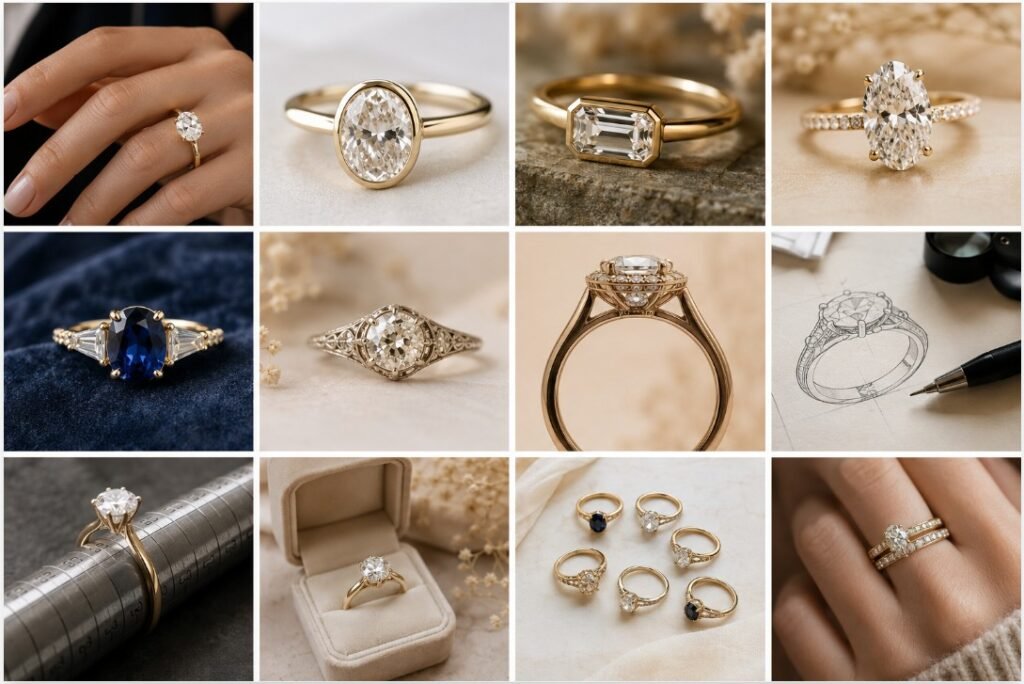
The biggest engagement ring trends in 2026 include lab-grown diamonds, oval and elongated diamond shapes, yellow gold, bezel settings, east-west settings, hidden halos, vintage-inspired rings, gemstone engagement rings, and sculptural bands.
Are lab-grown diamonds good for engagement rings?
Yes, lab-grown diamonds can be excellent for engagement rings. They have the same crystal structure and optical appearance as natural diamonds, but they usually cost less, allowing buyers to choose a larger stone or higher specifications for the same budget.
What diamond shape is most popular for engagement rings in 2026?
Oval diamonds remain one of the most popular choices because they look elegant, create strong finger coverage, and often appear larger than round diamonds of the same carat weight. Round brilliant diamonds are still the most timeless classic.
Are yellow gold engagement rings back in style?
Yes, yellow gold engagement rings are very popular again. They offer warmth, vintage character, and a luxurious look, especially with oval diamonds, emerald cuts, antique-inspired designs, champagne diamonds, and bezel settings.
What is an east-west engagement ring?
An east-west engagement ring sets the center stone horizontally across the finger instead of vertically. This creates a modern, architectural look and works especially well with oval, emerald-cut, marquise, and elongated cushion diamonds.
Are bezel engagement rings better than prong settings?
Bezel settings offer more protection because a rim of metal surrounds the stone. Prong settings usually allow more light to enter the diamond and create a more traditional look. The better choice depends on lifestyle, design preference, and how often the ring will be worn.
What engagement ring trend is best for everyday wear?
For everyday wear, bezel settings, low-profile settings, durable metals like platinum or 14k gold, and secure stone settings are excellent choices. Very thin bands, delicate pavé, and fragile gemstones may need more careful maintenance.
Are gemstone engagement rings a good idea?
Gemstone engagement rings can be beautiful and meaningful, but durability matters. Sapphires and diamonds are excellent for daily wear. Emeralds are stunning but more delicate. Softer stones like opal or pearl are generally risky for everyday engagement rings.
Should I choose a trendy or classic engagement ring?
The best choice is usually a balance of both. A ring can include modern details, such as a bezel setting or yellow gold, while still keeping a timeless shape and durable structure. Avoid choosing a ring only because it is currently popular.
How do I choose the best engagement ring trend for my partner?
Start with your partner’s lifestyle, jewelry style, preferred metal color, and daily habits. Then choose the diamond shape, setting, and design details that fit their taste. A good engagement ring should feel personal, comfortable, durable, and beautiful for many years.
