Emerald Cut Engagement Rings

Diamond Shape Guide
Emerald cut engagement rings do not sparkle in the loud, glittering way many people expect from diamonds. They do something more difficult: they stay composed. An emerald cut diamond flashes in long, clean steps of light, like a room with polished mirrors and very good manners.
This is the diamond shape for someone who prefers elegance over noise. It has straight lines, clipped corners, a broad table, and a calm architectural presence. Where a round brilliant tries to dazzle, an emerald cut asks to be looked at properly. It rewards a slower eye.
That restraint is exactly why emerald cut engagement rings feel so current again. Modern couples are moving toward rings with individuality, proportion, and quiet confidence. Vogue has highlighted emerald cuts as refined and understated, with a step-cut “hall of mirrors” effect rather than traditional brilliant sparkle, and 2026 trend coverage continues to show classic silhouettes like emerald cuts living comfortably beside more personal, design-led ring styles.
But an emerald cut is not a forgiving diamond shape. It reveals clarity, color, symmetry, and cutting choices more openly than many brilliant cuts. A great emerald cut can look impossibly expensive. A weak one can look glassy, flat, or empty. Buying this shape well requires discipline.
What Is an Emerald Cut Engagement Ring?
An emerald cut engagement ring features a center diamond with a rectangular shape, cropped corners, and long step-cut facets. Unlike round brilliant, oval, cushion, or radiant cuts, an emerald cut is not designed for maximum glitter. It is designed for broad flashes, depth, symmetry, and clarity of form.
The name comes from the way emerald gemstones were traditionally cut. Emeralds are more brittle than diamonds, so the clipped-corner rectangular style helped protect the stone while emphasizing its color and transparency. When applied to diamonds, the cut created a completely different kind of beauty: clean, linear, reflective, and unmistakably elegant.
The top of an emerald cut diamond has a large flat table. Beneath it, the facets descend in steps. This creates the famous hall-of-mirrors effect: long flashes of light that move across the stone rather than the intense scattered sparkle of a brilliant cut. It is less fireworks, more grand staircase.
Expert note: Emerald cut is a step cut, not a brilliant cut. If the wearer wants glitter from every angle, choose carefully. If they love clean flashes, symmetry, and quiet luxury, emerald cut can be exceptional.
The shape is usually rectangular, but emerald cuts vary in length-to-width ratio. Some are long and slim. Others are shorter and broader. A longer emerald cut can elongate the finger and feel more dramatic. A squarer emerald cut can feel more vintage or Art Deco, though if it becomes too square, it moves closer visually to an Asscher-style mood.
The clipped corners are not just decorative. They help protect the stone from chipping and give the diamond its distinctive outline. In a well-made ring, those corners should be properly supported by prongs, a bezel, or a setting designed to protect them.
An emerald cut engagement ring is best understood as a shape of restraint. It is not trying to be the sparkliest ring in the room. It is trying to be the most composed one.
Why Emerald Cut Engagement Rings Are Popular
Emerald cut engagement rings are popular because they feel elegant without looking overly familiar. They have enough history to feel timeless and enough geometry to feel modern. That combination is rare.
Many buyers are tired of rings that look algorithmically bridal: the same oval, the same hidden halo, the same thin pavé band, the same product-photo sparkle. Emerald cuts offer a different language. They are cleaner, quieter, more tailored. They feel like a silk column dress rather than a glittering ball gown.
The shape also carries strong design associations. Emerald cuts are connected to Art Deco jewelry, old Hollywood elegance, architectural minimalism, and style icons who prefer understatement. They look natural in platinum, yellow gold, three-stone rings, bezels, east-west settings, and clean solitaires. This makes them flexible without losing identity.
An emerald cut diamond does not chase attention. It assumes attention has decent taste and will arrive eventually.
Another reason emerald cuts are popular is their finger presence. Because the shape is elongated, an emerald cut can appear substantial on the hand. It may offer graceful coverage without the rounded softness of an oval or the sharp drama of a marquise. The straight lines create a lengthening effect while keeping the overall look crisp.
Emerald cuts also photograph beautifully in the right light. Their large facets create dramatic reflections and clean geometry. But this is exactly why buyers need to be cautious. The same broad facets that make a great emerald cut look refined can make a poor emerald cut look dull, watery, or transparent.
The current move toward individuality also supports emerald cuts. Trend reports for 2026 show buyers looking for rings with more personal style, stronger silhouettes, antique influence, bezel settings, sculptural bands, and less generic sparkle. Emerald cuts sit comfortably inside that shift because they already have character built into the cut.
Emerald Cut vs Radiant Cut
Emerald cut and radiant cut diamonds are often confused because both can be rectangular with clipped corners. The difference is in the facet style and the visual effect.
An emerald cut has step-cut facets. It produces long flashes, clean reflections, and a calm hall-of-mirrors look. A radiant cut has brilliant-style faceting. It produces more sparkle, more glitter, and often a busier light pattern. One is architectural. The other is energetic.
If the wearer loves sparkle and wants a rectangular diamond, radiant may be the better choice. If they love clean lines, elegance, and a quieter kind of luxury, emerald cut is usually stronger. Neither is better in a universal sense. They simply have different personalities.
Step-cut facets, broad flashes, visible clarity, elegant geometry, Art Deco mood, less glitter but more composure.
Brilliant-style faceting, stronger sparkle, more visual movement, rectangular outline with a livelier diamond personality.
Does your partner want clean mirror-like flashes or bright all-over sparkle? That answer usually decides the shape.
There is also a buying difference. Emerald cuts usually demand more attention to clarity because inclusions are easier to see through the broad table. Radiants can hide inclusions better because the faceting is more active. Emerald cuts may also show body color more clearly, especially in larger stones or white metal settings.
That does not mean emerald cuts must always be flawless and colorless. It means they need to be chosen with eyes open. An eye-clean emerald cut with graceful proportions can be magnificent. A paper-perfect emerald cut with poor life can still disappoint.
Clarity and Color for Emerald Cut Diamonds
Clarity matters more in emerald cut diamonds than in many brilliant cuts. The large table and open step facets do not hide inclusions as easily. In a round brilliant, small inclusions can disappear inside sparkle. In an emerald cut, the diamond behaves more like a clear window. If something is in the middle, you may see it.
That does not mean every emerald cut engagement ring needs a flawless diamond. Many buyers can choose a diamond that is eye-clean rather than technically perfect. The key is inclusion placement. A small mark near the edge may be far less noticeable than a dark crystal under the table. A feather hidden near a corner may be acceptable if it does not affect durability. A visible inclusion in the open center may become the only thing you see.
Color is also more visible in emerald cuts. Because the shape has broad facets and less scattered sparkle, warmth can show more clearly. In platinum or white gold, buyers often prefer higher color grades if they want a crisp white look. In yellow gold, slightly warmer diamonds can look more harmonious.
Buying warning: Do not buy an emerald cut diamond from grading numbers alone. A certificate can tell you color, clarity, and measurements, but it cannot fully show whether the stone looks alive, glassy, clean, or flat on the hand.
Transparency is another subtle issue. Some diamonds technically have acceptable grades but look hazy, milky, or sleepy. Emerald cuts do not forgive that. You want crisp reflections and clean internal life. If the diamond looks like a fogged window under normal lighting, keep looking.
Windowing is also important. A poorly cut emerald cut may allow you to see through the stone in a way that makes the center look empty. This is not elegance. This is leakage. The stone should have depth and flashes, not a dead transparent middle.
When comparing emerald cuts, view them in several lighting situations. Jewelry-store spotlights are flattering to almost everything. Softer daylight, office light, and indirect light reveal more truth. A great emerald cut does not need theatrical lighting to have presence.
Best Settings for Emerald Cut Engagement Rings
The best settings for emerald cut engagement rings respect the diamond’s geometry. This is not a shape that needs chaos around it. It needs proportion, clean metalwork, and a setting that understands straight lines.
A solitaire setting is the purest option. It lets the emerald cut speak clearly. The band can be slim, tapered, knife-edge, cathedral, or slightly wider depending on the desired mood. The danger with solitaires is making the setting too generic. With an emerald cut, small details matter: prong shape, basket design, shank thickness, and how the band meets the stone.
A bezel setting gives the emerald cut a strong architectural frame. It can look modern, secure, and exceptionally refined, especially in yellow gold or platinum. A full bezel emphasizes the rectangular outline. A half-bezel can feel lighter. East-west bezels are more fashion-forward and can look like fine jewelry rather than traditional bridal jewelry.
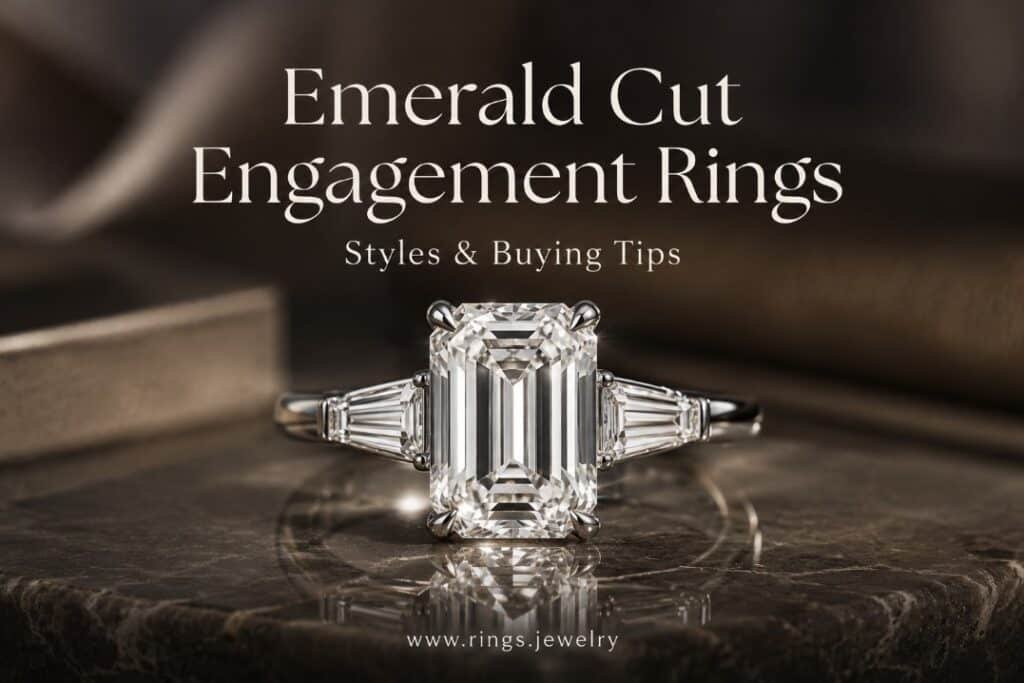
Three-stone settings are classic for emerald cuts. Tapered baguettes, trapezoids, side emerald cuts, half-moons, or shield-shaped side stones can all work. The side stones should support the center, not overpower it. A well-proportioned three-stone emerald cut ring can look heirloom-level elegant.
Hidden halos and pavé bands can be used, but they require restraint. Emerald cuts have a quiet personality. Too much glitter around them can feel like putting chandelier earrings on a minimalist sculpture. Sometimes it works. Often it distracts.
Setting principle: Emerald cuts look best when the setting has discipline. Clean prongs, sharp proportions, and thoughtful side stones usually do more than excessive sparkle.
Low-profile settings can be beautiful, but check wedding band fit. Some emerald cut rings sit too low for a straight band to sit flush. This is not a problem if the wearer likes a gap or plans a curved band. It is a problem if no one mentions it until the wedding band appointment.
Emerald Cut Solitaire Rings
An emerald cut solitaire engagement ring is one of the cleanest bridal designs possible. It is just the stone and the setting, with no decorative apology. This can be stunning when the diamond is strong.
The solitaire puts pressure on the center stone. The clarity must be acceptable. The color must suit the metal. The symmetry must look balanced. The table should not look lifeless. The length-to-width ratio should flatter the hand. There are no side stones to distract from a weak center.
Band width changes the entire mood. A slim band makes the emerald cut feel delicate and elongating. A slightly thicker band makes it feel more modern and grounded. A knife-edge band adds a crisp line. A cathedral setting gives more structure. A plain rounded shank softens the geometry.
Bench detail: On emerald cut solitaires, prong placement is very visible. The corners should be protected without covering too much of the clipped-corner shape. Bulky prongs can make the ring look unfinished.
Four-prong emerald cut settings are common, but the prongs must protect the corners properly. Double claw prongs can look refined on larger stones. Bezel or half-bezel solitaires can be excellent if the wearer wants a smoother profile.
Emerald cut solitaires also pair beautifully with wedding bands. A plain band keeps the look very clean. A baguette band adds Art Deco rhythm. A pavé band adds sparkle without altering the engagement ring itself. A wide gold band can make the stack feel more editorial.
The best emerald cut solitaire does not look empty. It looks edited.
Emerald Cut Bezel Engagement Rings
Emerald cut bezel engagement rings are among the most architectural versions of the style. The bezel outlines the diamond with a continuous metal frame, emphasizing the rectangular shape and clipped corners.
This can make the ring feel modern, secure, and quietly luxurious. In yellow gold, the bezel adds warmth and vintage-modern character. In platinum, it feels crisp and gallery-like. In brushed or satin metal, it can become almost sculptural.
The bezel also protects the diamond’s edges. Emerald cuts have corners that need thoughtful setting. A bezel can reduce snagging and shield the perimeter better than exposed prongs. This makes it appealing for daily wear, especially for someone who wants a smooth, low-profile ring.
Choose an emerald cut bezel if:
You want a clean outline, smooth wear, strong edge protection, and a ring that feels more design-led than traditionally bridal.
Be cautious if:
You want the diamond to look very open, airy, and prong-set, or if you dislike a stronger metal frame around the stone.
The challenge is bezel thickness. A heavy bezel can make an emerald cut look smaller or more severe. A fine bezel can make it look expensive and intentional. The rim should be even, the corners clean, and the side profile graceful.
Half-bezel emerald cut rings are another option. They can secure the stone while leaving more of the long sides or ends visually open, depending on the design. This gives a lighter look but still keeps some of the bezel’s smoothness.
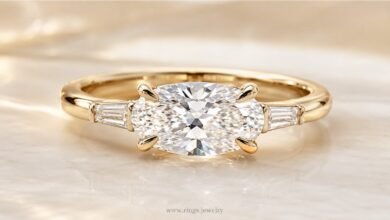
East-west emerald cut bezels are more fashion-forward. Turning the diamond horizontally gives the ring a modern fine-jewelry mood. It can be spectacular on the right hand, but scale matters. A long emerald cut set east-west can become wide across the finger, so try the proportions visually before committing.
Emerald Cut Three-Stone Rings
Emerald cut three-stone engagement rings can be extraordinary because the center stone already has a strong geometry. The side stones can extend that geometry, soften it, or add contrast.
Tapered baguettes are the classic choice. They create a graceful transition from the center emerald cut into the band, almost like architectural shoulders. This combination feels refined, balanced, and very old Hollywood when done well.
Trapezoid side stones create a wider, more geometric look. They can make the ring feel more substantial and custom. Half-moon side stones soften the rectangular center and add a curved line. Side emerald cuts create a strong Art Deco effect. Shield or bullet side stones can look striking, but they require a confident wearer and excellent proportions.
The danger with three-stone emerald cut rings is width. Too much horizontal spread can make the ring uncomfortable or visually heavy. The side stones should not rub neighboring fingers or overpower the center diamond. A three-stone ring should feel composed, not crowded.
Common mistake: choosing large side stones because they look impressive in a tray. On the hand, oversized side stones can make an emerald cut ring feel bulky and less elegant.
Matching matters too. Side stones should complement the center’s color and clarity. They do not need identical grades in every case, but they should not look obviously mismatched. With step cuts, differences can be more noticeable because the stones are visually cleaner and less sparkly.
A three-stone emerald cut ring is a strong choice for someone who wants heirloom presence. It feels more formal than a solitaire and often more timeless than decorative pavé. It can be luxurious without looking trendy.
Best Metals for Emerald Cut Engagement Rings
Emerald cut engagement rings respond strongly to metal choice because the shape is so clean. The metal becomes part of the architecture.
Platinum is a classic choice for emerald cuts. It gives the diamond a cool, crisp frame and supports the stone’s refined personality. Platinum is dense, durable, and prestigious, though it develops patina over time. For buyers who love a white-metal look and want long-term seriousness, platinum is excellent.
Yellow gold makes an emerald cut feel warmer and more vintage-modern. It can soften the diamond’s geometry and work beautifully with slightly warmer stones. Yellow gold bezels and three-stone emerald cut rings are especially strong right now because they combine structure with warmth.
White gold offers a bright white look at a lower cost than platinum, but it usually requires rhodium plating to maintain its icy finish. Over time, replating may be needed. White gold can be beautiful, but buyers should understand the maintenance.
Rose gold gives emerald cuts a softer, more romantic tone. It is less traditional for this shape but can be striking, especially with a vintage-inspired or custom setting. It should match the wearer’s existing jewelry style rather than being chosen only because it looks interesting in a render.
For very color-sensitive buyers, white metals may make diamond warmth more noticeable. Yellow gold can make warmth feel more harmonious. This matters because emerald cuts reveal color more openly than many brilliant cuts. The best metal is not just the trendiest one; it is the one that makes the diamond and the wearer look best together.
How to Buy an Emerald Cut Engagement Ring
Buying an emerald cut engagement ring starts with accepting that this is a more revealing diamond shape. You cannot rely on sparkle to hide everything. You need to judge clarity, color, symmetry, proportions, transparency, and setting design carefully.
First, choose the preferred length-to-width ratio. A longer emerald cut feels elegant and finger-lengthening. A shorter emerald cut feels more balanced and sometimes more vintage. Look at the stone on a hand, not only in a loose diamond video.
Second, inspect clarity with your actual eyes. The diamond should be eye-clean to the wearer’s standards. Do not obsess over the grade alone. A lower clarity stone with well-placed inclusions may look better than a higher clarity stone with a visible mark in the center.
Third, check color in the metal you plan to use. A diamond that looks white enough in yellow gold may look warmer in platinum. A stone that looks crisp in studio lighting may show more body color in daylight. Emerald cuts are elegant, not secretive.
Fourth, look for life in the stone. You want broad flashes that move. You do not want a flat glass rectangle. Rotate the diamond. Watch the steps. Look for contrast, symmetry, and depth.
Buying principle: With emerald cuts, choose the most beautiful stone you can see, not the most impressive certificate you can read.
Fifth, choose the setting according to lifestyle. A solitaire is pure and timeless. A bezel is smooth and modern. A three-stone ring adds heirloom presence. An east-west setting feels more fashion-forward. A pavé band adds sparkle but requires more maintenance. A low setting may be comfortable but may not sit flush with a wedding band.
For a wider overview of ring styles, diamond shapes, metals, and budget decisions, see our detailed engagement ring guide before choosing the final setting.
Finally, judge the ring from the side. Emerald cut rings often look perfect from above and awkward from the profile if the basket is too bulky, the stone sits too high, or the band meets the head poorly. Side view is where craftsmanship confesses.
The best emerald cut engagement ring feels calm, clean, and deliberate. It should not look like a brilliant-cut diamond trying to sparkle less. It should look like a step-cut diamond doing exactly what it was designed to do: reflect light in long, elegant flashes and make the wearer look like they chose with confidence.
Final expert judgment
Choose an emerald cut engagement ring if the wearer loves clean lines, understated luxury, Art Deco influence, and mirror-like flashes instead of all-over sparkle. Be stricter with clarity, color, transparency, and symmetry than you might be with many brilliant cuts. The safest beautiful settings are solitaires, bezels, and well-proportioned three-stone rings. A great emerald cut does not need to be loud. It needs to be clear, balanced, and impossible to mistake for anything ordinary.
FAQ
What is an emerald cut engagement ring?
An emerald cut engagement ring features a rectangular step-cut diamond with clipped corners and long linear facets. It creates broad flashes of light instead of the intense sparkle of brilliant cuts.
Are emerald cut engagement rings popular?
Yes. Emerald cut engagement rings are popular because they look elegant, architectural, timeless, and refined. They are especially loved by people who prefer understated luxury over heavy sparkle.
Do emerald cut diamonds sparkle less?
Emerald cut diamonds sparkle differently. They show broad flashes and a hall-of-mirrors effect rather than the glittery brilliance of round, oval, or radiant cuts.
Is clarity important for emerald cut diamonds?
Yes. Clarity is very important because emerald cuts have a large table and open facets that reveal inclusions more easily than many brilliant cuts.
What color grade is best for an emerald cut diamond?
The best color grade depends on size, metal, and personal preference. White metals usually make warmth more visible, while yellow gold can make slightly warmer diamonds look more harmonious.
What setting is best for emerald cut engagement rings?
Solitaire, bezel, and three-stone settings are among the best options. Emerald cuts usually look strongest in clean settings that respect their geometry.
Are emerald cut bezel engagement rings a good choice?
Yes. Emerald cut bezel rings are modern, secure, and architectural. A refined bezel protects the stone’s edge and emphasizes the clean rectangular outline.
What is the difference between emerald cut and radiant cut?
Emerald cuts have step-cut facets and broad flashes. Radiant cuts have brilliant-style faceting and more all-over sparkle. They may look similar in outline but behave very differently in light.
Do emerald cut diamonds look bigger?
Emerald cuts can look large because of their elongated rectangular shape, but face-up size depends on measurements, depth, and proportions rather than carat weight alone.
Are emerald cut engagement rings timeless?
Yes. Emerald cut engagement rings are considered timeless because of their clean geometry, Art Deco heritage, and refined understated style.
Can emerald cut rings sit flush with a wedding band?
Some can, especially higher settings. Low bezels or low baskets may leave a gap. Always check the side profile before buying if a flush wedding band is important.
Who should choose an emerald cut engagement ring?
Emerald cuts are ideal for someone who loves clean lines, minimalism, vintage elegance, Art Deco style, and quiet luxury rather than maximum sparkle.