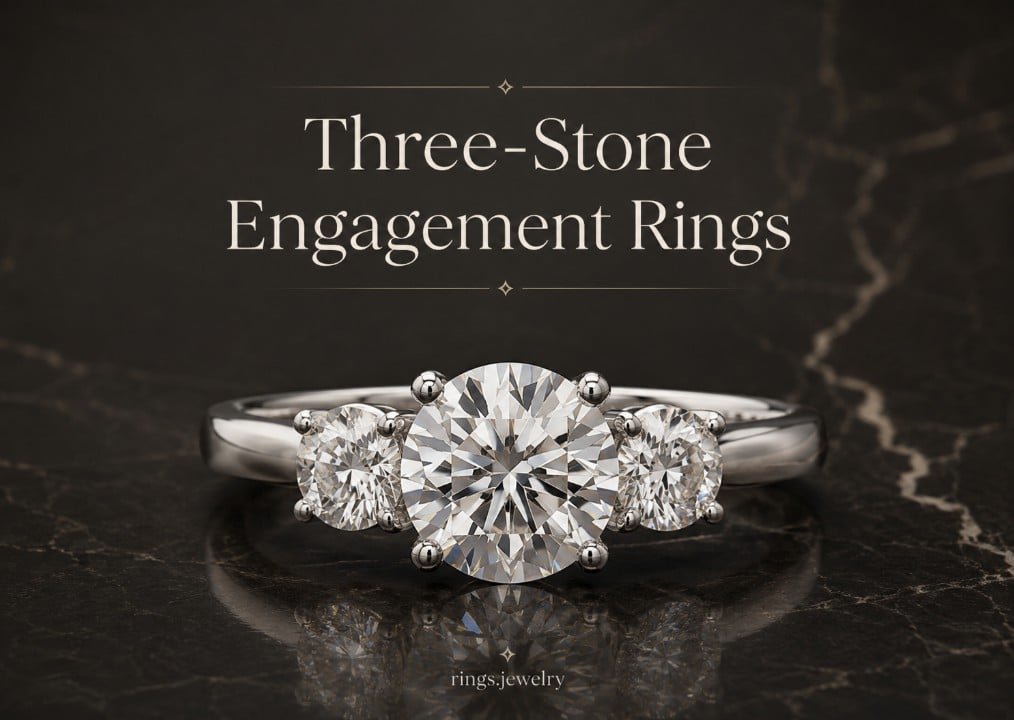
Three-Stone Engagement Rings

Symbolic Setting Guide
Three-stone engagement rings have a rare advantage: they can be deeply symbolic without looking sentimental in the wrong way. One center stone, two companions, and suddenly the ring has rhythm, balance, and a story built into its structure.
The traditional meaning is simple and powerful: past, present, and future. The center stone represents the present — the commitment being made now — while the side stones frame the relationship’s history and what is still ahead. Sotheby’s notes that De Beers helped popularize this symbolism in a 2001 three-stone diamond ring campaign, and the meaning has remained attached to the style ever since.
But a three-stone engagement ring is not only a romantic metaphor. It is also a design challenge. Side stones can make a ring look grand, graceful, architectural, vintage, soft, or dramatic. They can also make it look crowded, overbuilt, mismatched, or awkward on the hand. The difference is proportion.
A beautiful three-stone ring should feel like a composition, not a diamond argument. The side stones should support the center. The band should carry the width. The setting should sit comfortably. The whole piece should look intentional from above, from the side, and in motion.
What Is a Three-Stone Engagement Ring?
A three-stone engagement ring has one center stone flanked by two side stones. The center stone is usually larger, while the side stones are chosen to frame it, widen the ring’s visual presence, and create meaning or design contrast.
This style is also called a trilogy ring. In the most traditional interpretation, the three stones represent a couple’s past, present, and future. That symbolism is one reason the design has remained so beloved: it feels more narrative than a solitaire, but not as decorative as many halo or pavé-heavy styles.
The three stones do not have to be identical. In fact, the best three-stone rings often use contrast. A round center diamond with pear side stones. An emerald cut center with tapered baguettes. An oval center with half-moon side stones. A cushion center with trapezoids. A sapphire center with diamond sides. The structure is classic; the personality can change completely.
What defines the ring is the relationship between the stones. The side stones should not feel like two random extras added to increase sparkle. They should have a reason: to lengthen the silhouette, soften the center shape, add symmetry, introduce color, create vintage energy, or make the ring feel more substantial without relying on a halo.
In plain jeweler language: a three-stone ring succeeds when the eye lands on the center first, then enjoys the side stones second. If all three stones fight for attention equally, the ring may feel busy rather than luxurious.
Three-stone rings can be delicate or grand. They can be made with small side stones for a subtle effect, or with large matching stones for serious finger coverage. The setting can be prong-set, bezel-set, low-profile, cathedral, vintage-inspired, or sculptural. The design can lean heirloom, modern, romantic, Art Deco, minimalist, or dramatic.
That flexibility is exactly why this setting deserves careful planning. A solitaire can survive a little design laziness because the concept is so simple. A three-stone ring has more moving parts. Every stone, angle, shoulder, prong, and height decision matters.
Why Three-Stone Rings Feel Current Again
Three-stone engagement rings feel current because the bridal market is moving away from one-size-fits-all rings. Vogue’s 2026 engagement ring trend coverage describes a shift away from the more homogeneous styles of the early 2000s and 2020s toward designs with individuality, history, craft, and personal resonance. Three-stone rings fit that shift beautifully because they can hold meaning without becoming overly literal.
They also answer the desire for presence. A three-stone ring can create more width across the finger than a solitaire of the same center stone size. That does not mean it must look enormous. It means the design has more architecture. The side stones extend the composition and make the ring feel complete.
Another reason the style feels relevant is the rise of customization. Rare Carat’s 2026 trend coverage includes three-stone designs among styles shaping the year ahead, alongside personalization, modern settings, and larger lab-grown options. Three-stone rings are naturally customizable because the side stones can change the entire mood.
A three-stone ring is not simply a solitaire with company. It is a small piece of choreography: center, left, right, and the space between them.
There is also a quiet-luxury reason. Three-stone rings can look expensive without relying on excessive pavé or flashy decoration. A clean emerald cut with tapered baguettes, for example, has a kind of tailored confidence. A round diamond with pear side stones feels classic but feminine. An oval with half-moons can look soft and custom. These are not novelty designs; they are proportion-driven designs.
The style also works well with both natural and lab-grown diamonds. A natural diamond buyer may choose modest side stones to add presence without increasing center stone size dramatically. A lab-grown buyer may create a larger, more dramatic three-stone look within a budget that would be much more difficult with natural diamonds. In both cases, the same rule applies: size without proportion is not luxury. It is just acreage.
Center Stone and Side Stone Balance
The most important part of a three-stone engagement ring is balance. Not mathematical symmetry alone, but visual hierarchy. The center stone should remain the center. The side stones should make it look more important, not less.
One classic approach is to choose side stones that are noticeably smaller than the center stone. This creates a clear focal point. The ring feels elegant, wearable, and less crowded. Another approach is to use larger side stones for a bold trilogy look, where all three stones have strong presence. This can be stunning, but it needs a hand and setting that can carry the width.
The side stones should also match the center stone’s personality. A brilliant round center can handle pear, round, or tapered baguette sides. An emerald cut center often looks best with step-cut companions such as tapered baguettes, trapezoids, or side emerald cuts. An oval center can work with pear sides, half-moons, tapered baguettes, or smaller ovals. A cushion center can become romantic with half-moons or more antique with trapezoids.
When side stones are too small:
The ring may look like a solitaire with nervous decorations. The sides disappear, and the trilogy idea loses strength.
When side stones are too large:
The center stone can lose authority. The ring may become wide, heavy, or uncomfortable between neighboring fingers.
Height matters too. The center stone is often set slightly higher than the side stones to create emphasis. But “higher” should not mean unstable or snag-prone. A ring can have hierarchy without looking like the center diamond is standing on a balcony.
Side-stone angle is another quiet detail. Side stones can sit flat, gently angled upward, or tucked toward the center. The angle affects how the ring wraps the finger and how the stones catch light. Poorly angled side stones can make the ring look stiff or make the side stones rub against adjacent fingers.
Color and clarity matching also need judgment. Side stones do not always need the exact same grade as the center, but they should look harmonious. If the center is very white and the sides are visibly warmer, the mismatch may bother the wearer. If the center is an emerald cut and the side stones are step cuts, clarity becomes more visible across the whole design.
Best Diamond Shapes for Three-Stone Rings
Three-stone engagement rings depend heavily on shape pairing. The center stone sets the mood; the side stones decide whether that mood becomes graceful, formal, romantic, or dramatic.
Round center with pear side stones is one of the most enduring combinations. The round diamond gives classic sparkle, while pear sides create softness and movement. This pairing feels bridal, balanced, and flattering. It is especially good for someone who wants tradition with a little more shape than a solitaire.
Oval center with half-moon or pear sides creates a romantic silhouette with strong finger coverage. Half-moons hug the oval gently and can make the ring feel custom. Pear sides create a more classic three-stone look. The oval must be chosen carefully for bow-tie effect and proportion; side stones will not fix a weak center.
Emerald cut center with tapered baguettes is the tailored suit of three-stone rings. Clean, linear, and quietly expensive. The step-cut side stones extend the geometry of the center without adding unnecessary glitter. This is ideal for someone who loves Art Deco elegance, minimalism, or architectural jewelry.
Cushion center with trapezoid or half-moon sides can be soft, vintage, and full of character. Antique cushions and old mine-inspired diamonds are especially beautiful in three-stone settings because the side stones can enhance the heirloom mood. The ring should not become too bulky; cushions already have visual weight.
Radiant center with trapezoid sides gives sparkle and structure. A radiant has more brilliance than an emerald cut but still offers a rectangular outline. Trapezoids can frame it cleanly. This style can look glamorous, especially with a larger center stone, but the faceting of the radiant must be lively rather than chaotic.
Marquise center with tapered side stones is more unusual and dramatic. It can be elegant on the right hand, but the shape already has strong personality. Side stones should be chosen carefully so the ring does not become too pointed or theatrical.
Round center with pear or round side stones. Balanced, bridal, and easy to love long-term.
Emerald cut center with tapered baguettes. Crisp, architectural, and ideal for quiet luxury.
Oval center with half-moon or pear sides. Soft, flattering, and very strong for modern engagement rings.
Colored side stones are also possible. Sapphire side stones can add meaning and contrast. Champagne diamonds can create a warm tonal look. Birthstones can make the ring personal, though durability must be considered. Not every gemstone is suitable for daily wear beside a diamond. Beauty is lovely; hardness and toughness still matter.
Classic Three-Stone Ring Styles
The classic three-stone ring has a center diamond with two smaller diamonds on either side, usually in a symmetrical layout. The style is traditional because it works. It gives the ring presence, symbolism, and balance without needing trend language.
The most familiar classic version uses a round brilliant center with round or pear-shaped side stones. It has sparkle, softness, and a clear bridal identity. This is a good choice for someone who wants a meaningful ring that still feels timeless. It also pairs well with platinum, white gold, yellow gold, and rose gold.
Another classic version is the emerald cut with tapered baguettes. This design has been associated with refined jewelry for decades because it is clean and composed. The side baguettes do not compete; they guide the eye toward the center. The result can look formal without being stiff.
Oval three-stone rings are becoming modern classics. They offer the finger-lengthening effect of an oval with the added width of side stones. Pear sides make the ring romantic. Half-moons make it softer and more custom. Tapered baguettes make it more tailored.
Atelier check: In classic three-stone rings, the side stones should look like they belong to the center stone’s world. If the center is soft and romantic, the sides should not feel harsh. If the center is architectural, the sides should not look sugary.
Classic does not mean plain. A classic three-stone ring can still have claw prongs, a delicate gallery, a cathedral shoulder, a low basket, hand engraving, or a slightly tapered shank. The key is editing. One refined detail is often enough.
The wedding band plan should be considered early. Some three-stone settings sit wide or low, which may leave a gap with a straight band. That can look elegant if intentional, especially with a curved band or custom contour. But if the wearer wants a perfectly flush straight band, the engagement ring setting must be planned around that from the beginning.
Modern Three-Stone Ring Styles
Modern three-stone engagement rings are less strict about tradition. They may use unusual side-stone shapes, mixed cuts, colored stones, east-west center stones, bezel settings, chunkier bands, asymmetric proportions, or warm yellow gold. The meaning remains, but the styling becomes more personal.
One of the strongest modern approaches is the mixed-cut three-stone ring. For example, an oval center with step-cut trapezoids, or an emerald cut center with half-moons. The contrast makes the ring feel designed rather than selected from a standard tray.
Another modern option is the bezel three-stone ring. Bezels give each stone a defined outline and can make the ring smoother for daily wear. A bezel-set emerald cut center with tapered side stones can feel architectural. A bezel-set oval with half-moons can feel modern and soft. The bezel must be fine enough to avoid making the ring too heavy.
Yellow gold has also changed the look of three-stone rings. A yellow gold trilogy ring can feel warmer, less formal, and more current than the same ring in white metal. It works especially well with antique cuts, cushions, ovals, and emerald cuts. The gold adds atmosphere.
The modern three-stone ring is not trying to abandon tradition. It is trying to make tradition look like it has a private stylist.
Asymmetry can work, but it is risky. A ring with one side stone shape on the left and another on the right can be beautiful if designed by a skilled jeweler. It can also look like a repair project. For engagement rings, asymmetry should feel deliberate, balanced, and wearable.
Colored stones can bring meaning. Blue sapphires, champagne diamonds, green sapphires, or birthstones can make the design personal. For daily wear, durability is essential. Sapphire is a strong option. Emerald is beautiful but more delicate. Opal, pearl, and many softer stones are usually poor choices for an engagement ring worn every day.
Modern three-stone rings are best when they still respect proportion. A design can be unusual without being chaotic. The stones should create a line across the finger that feels intentional, comfortable, and visually balanced.
Three-Stone Rings by Metal
Metal choice has a strong effect on three-stone engagement rings because there is more setting structure visible than in a simple solitaire. The metal connects the stones, frames the composition, and influences the ring’s mood.
Platinum is a classic choice for three-stone diamond rings. It feels substantial, cool, and refined. It is especially strong for emerald cuts, baguettes, trapezoids, and more formal designs. Platinum also has a serious long-term quality, though it develops patina rather than staying mirror-bright forever.
Yellow gold gives three-stone rings warmth and character. It is excellent for antique-inspired designs, oval centers, cushion centers, and rings with a slightly vintage mood. Yellow gold can also make slightly warmer diamonds look more harmonious, which can help when balancing budget and beauty.
White gold creates a bright bridal look at a lower cost than platinum, but it usually requires rhodium plating to maintain its white finish. For detailed three-stone settings with pavé or side stones, maintenance should be considered.
Rose gold makes three-stone rings softer and more romantic. It can be beautiful with oval, cushion, and round centers, especially if the wearer already loves rose-toned jewelry. It should not be chosen only because it looks warm in product photos; the wearer must enjoy that color daily.
Mixed metals can work in custom designs. A platinum head on a yellow gold shank, for example, can make a diamond appear whiter while keeping the warmth of gold on the band. This approach should be used thoughtfully, not as a random compromise.
Material reality: three-stone rings have more settings, more prongs, and more contact points than solitaires. Metal choice matters, but construction quality matters even more.
The metal should also match the scale of the ring. A very delicate gold shank may not visually or structurally support a wide three-stone design. A heavier platinum band may overpower smaller stones. The ring should feel like one object, not three diamonds temporarily sharing transportation.
Comfort, Wear, and Wedding Band Fit
Three-stone rings can be very wearable, but they need more comfort planning than many solitaires. The main issue is width. Side stones extend across the finger, and if they are too large or set too low, they can press against neighboring fingers.
This is especially important for smaller hands. A ring that looks beautifully generous in a close-up photo may feel wide in real life. The side stones should enhance the center, not occupy the entire finger like a tiny diamond bridge.
Setting height also matters. Low settings can be comfortable and elegant, but they may prevent a straight wedding band from sitting flush. Higher settings may allow a flush band, but they can snag more. The best answer depends on the wearer’s lifestyle and preferred stack look.
Prong placement must be checked carefully. More stones mean more prongs. More prongs mean more points that can catch, wear, bend, or need maintenance. The prongs should be smooth, even, and properly finished. They should protect the stones without looking bulky.
A mistake worth avoiding: designing the engagement ring as if the wedding band will never exist. Three-stone settings can be gorgeous, but the band pairing should be planned before the ring is finished.
Cleaning also takes more attention. Dirt and lotion can collect under side stones and around galleries. Open settings are often easier to clean than closed, overly complicated ones. If the ring has pavé, hidden details, or side stones tucked tightly against the center, maintenance becomes more important.
Daily-wear habits matter. A three-stone ring is not too delicate by nature, but any ring can be damaged by heavy lifting, gym equipment, hard knocks, chemicals, or careless wear. The larger and more exposed the side stones are, the more thoughtful the wearer should be.
A well-made three-stone ring should feel comfortable enough to wear often, not so precious that it becomes a special-occasion object. Engagement rings are emotional, yes, but they are also worn by hands — and hands are not gentle museum displays.
Buying a Three-Stone Engagement Ring
When buying a three-stone engagement ring, start with the center stone. The center stone determines the ring’s identity. Side stones should be chosen after the center’s shape, size, color, clarity, and personality are clear.
Then decide what the side stones should do. Do you want them to add romance, geometry, width, sparkle, symbolism, color, or vintage character? Pear sides and half-moons soften. Baguettes and trapezoids sharpen. Round sides add classic sparkle. Colored sides add personality. Each choice has a job.
Next, compare scale on the hand. This cannot be judged only from loose stone images. A three-stone ring changes dramatically once the stones are set together. Try to view similar layouts on a hand with similar finger size if possible.
Ask about matching. Side stones should be matched for shape, size, color, and quality. In step-cut designs, matching is especially visible. In brilliant-cut designs, small differences may be less obvious, but they still matter.
Look at the side profile. The stones should sit in a graceful line, not in three awkward towers. The gallery should be clean. The band should meet the stones naturally. The ring should not feel top-heavy.
Private showroom test: cover the side stones with your fingers for a moment. If the center stone suddenly looks better alone, the side stones are not helping. They are just expensive company.
For the full buying process across shapes, metals, settings, and budget decisions, see our Engagement Rings guide before choosing the final design.
Finally, be realistic about maintenance. A three-stone ring has more stones to check, more prongs to inspect, and more surfaces to clean. That is not a reason to avoid it. It is a reason to buy quality. A well-made three-stone ring can become an heirloom. A poorly made one can become a recurring appointment.
Who Should Choose a Three-Stone Ring?
A three-stone engagement ring is ideal for someone who wants symbolism, presence, and design richness without necessarily choosing a halo. It suits a wearer who likes meaningful jewelry, balanced compositions, and rings that feel complete from the first glance.
It is also a strong choice for someone who wants more finger coverage than a solitaire but does not want the center stone surrounded by a traditional halo. Side stones add width in a more architectural way. The ring can feel substantial while still allowing the center diamond to remain the star.
Choose a three-stone ring for someone who loves classic romance, Art Deco lines, vintage inspiration, or custom-looking design. A round with pear sides feels soft and bridal. An emerald cut with baguettes feels tailored. An oval with half-moons feels elegant and modern. A cushion with trapezoids can feel antique and soulful.
Be cautious if the wearer prefers very minimal jewelry, very low-profile rings, or extremely delicate bands. Three-stone rings can be made refined, but they are naturally more visually present than solitaires. That presence should match the person.
Also be cautious if the wearer is hard on jewelry. A three-stone ring can absolutely be worn daily, but the design should be built for that: secure prongs, protected corners, practical height, enough metal strength, and side stones that do not protrude too aggressively.
The best three-stone engagement ring feels symbolic without becoming sentimental decoration. It should look balanced on the hand, beautiful from the side, and personal enough that the wearer does not feel like they chose a standard setting. Three stones can tell a story. The jeweler’s job is making sure the story is well edited.
Last look before choosing
A three-stone engagement ring is one of the strongest choices for someone who wants meaning, presence, and elegance in one design. Choose the center stone first, then let the side stones support its shape and personality. Keep the proportions disciplined, the setting comfortable, the wedding band plan realistic, and the craftsmanship sharp. When the balance is right, a three-stone ring does not look like more diamonds for the sake of more diamonds. It looks like a promise with structure.
FAQ
What is a three-stone engagement ring?
A three-stone engagement ring has one center stone with two side stones. It is also called a trilogy ring and often symbolizes a couple’s past, present, and future.
What do three-stone engagement rings mean?
The traditional meaning is past, present, and future. The side stones represent the relationship’s history and future, while the center stone represents the present commitment.
Are three-stone engagement rings popular?
Yes. Three-stone engagement rings remain popular because they combine symbolism, finger coverage, and design flexibility. They can look classic, vintage, modern, or custom depending on the stones.
What diamond shapes are best for three-stone rings?
Round, oval, emerald cut, cushion, radiant, and pear centers can all work. Popular side stones include pears, tapered baguettes, trapezoids, half-moons, and smaller round diamonds.
Are three-stone rings more expensive than solitaires?
Usually, yes. Three-stone rings often cost more because they require side stones, more setting labor, more matching, and more metalwork than a simple solitaire.
Do three-stone engagement rings make the center diamond look bigger?
They can make the overall ring look larger and more substantial, but they do not necessarily make the center stone itself look bigger. The effect depends on side-stone size and proportions.
What is the best metal for a three-stone engagement ring?
Platinum is classic and durable, yellow gold adds warmth and vintage character, white gold gives a bright bridal look, and rose gold creates a softer romantic style.
Can a three-stone ring sit flush with a wedding band?
Some three-stone rings can sit flush, but many low or wide settings may leave a gap. Check the side profile and wedding band fit before finalizing the design.
Are three-stone engagement rings timeless?
Yes. A well-proportioned three-stone ring can be very timeless, especially with classic combinations like round with pear sides or emerald cut with tapered baguettes.
Who should choose a three-stone engagement ring?
A three-stone engagement ring is ideal for someone who wants symbolism, more presence than a solitaire, and a balanced design with meaningful side stones.