
14k vs 18k Gold Engagement Ring: Which Is Better for Daily Wear?
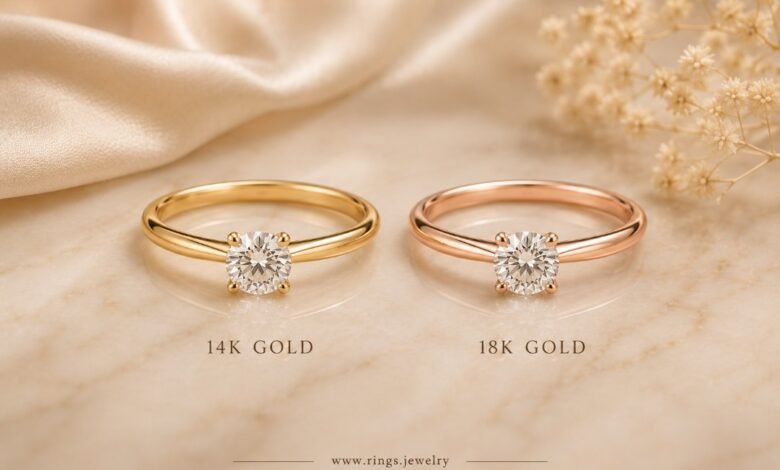
Choosing between a 14k and 18k gold engagement ring sounds like a tiny technical detail until you realize it affects almost everything: color, strength, price, daily wear, resizing, pavé security, and how the ring ages on the hand.
Both are real gold. Both can be beautiful. Both can be used for engagement rings. The better choice depends less on which number sounds more luxurious and more on how the ring will be worn, what metal color you want, how delicate the design is, and whether the wearer is gentle with jewelry or lives like their hands have a full-time job.
The honest answer from the bench: 18k gold often looks richer, especially in yellow gold, while 14k gold is usually more practical for daily wear. But that sentence alone is too simple. A delicate pavé ring, a wide yellow gold solitaire, a thin band with a large diamond, and a classic rose gold engagement ring do not all need the same answer.
First, What Do 14k and 18k Gold Actually Mean?
Gold used in engagement rings is almost never pure gold. Pure 24k gold is too soft for most engagement ring designs, especially rings with prongs, pavé, delicate bands, or center stones that need secure long-term support.
That is why jewelers use gold alloys. An alloy blends pure gold with other metals to improve strength, adjust color, and make the ring suitable for real wear. The karat number tells you how much pure gold is in the alloy.
The gold content
- 14k gold contains 58.3% pure gold, with the remaining percentage made of alloy metals.
- 18k gold contains 75% pure gold, which gives it a richer gold content and often a warmer color.
This is where the confusion begins. More gold sounds automatically better. In one sense, 18k gold is more precious because it contains more pure gold. But engagement rings are not just metal samples. They are wearable architecture. The ring has to hold its shape, protect the diamond, resist daily pressure, and survive years of ordinary life.
So the real question is not “which has more gold?” The better question is: which alloy makes the most sense for this ring, this wearer, and this design?
The Fast Choice If You’re Standing in a Jewelry Store
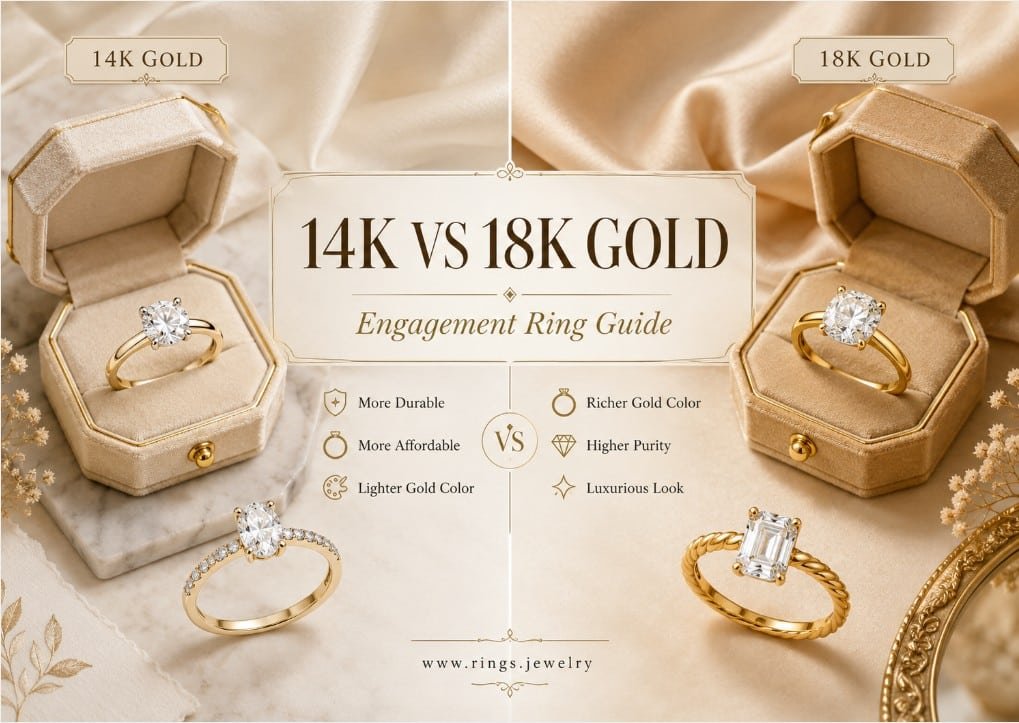
Choose 14k gold if you want a practical engagement ring for daily wear, especially if the design is thin, pavé, delicate, or likely to experience more hand activity. Choose 18k gold if you want a richer gold content, warmer color, and a more luxurious feel, especially in yellow gold or simpler designs with enough structure. Neither option is universally better. 14k gold usually wins for durability and value; 18k gold usually wins for richness of color and gold purity.
The Color Difference: Where 18k Gold Starts Flirting
Color is where 18k gold often seduces buyers. Because it contains more pure gold, 18k yellow gold usually looks warmer, deeper, and more saturated than 14k yellow gold. It has that old-world jewelry glow — less “bright metal,” more “heirloom in a velvet tray.”
14k yellow gold is still unmistakably gold, but it can look slightly softer or lighter depending on the alloy. Some buyers prefer this because it feels more understated and easier to wear every day. Others look at 18k yellow gold and immediately understand why jewelers still speak about it with a little romance.
In rose gold, the difference can be more nuanced. Rose gold gets its blush tone from copper in the alloy. Since 14k has more alloy content than 18k, 14k rose gold can sometimes appear a bit pinker or stronger in tone, while 18k rose gold may feel warmer, softer, and more golden.
White gold is a different conversation. Both 14k and 18k white gold are alloyed to look whiter, and most white gold engagement rings are rhodium plated for a bright white finish. That means the visible surface can look similar at first, even though the underlying alloy differs.
Practical and slightly softer
14k yellow gold often looks a little lighter than 18k. It can be ideal if you want gold warmth without an intensely rich tone.
Richer and more saturated
18k yellow gold usually has a deeper, warmer color because it contains more pure gold. It feels more traditional, luxurious, and jewel-like.
If you are choosing yellow gold specifically, it is worth looking at our guide to yellow gold engagement ring styles because color, setting shape, and diamond tone all change how rich the final ring feels.
The Durability Conversation Nobody Should Skip
Here is where 14k gold gets serious.
Because 14k gold contains more alloy metal and less pure gold than 18k, it is generally harder and more resistant to everyday wear. That does not make it indestructible. It simply gives it a practical advantage for engagement rings that will be worn constantly.
18k gold contains more pure gold, which gives it beauty and richness, but pure gold is softer. In many engagement ring designs, especially delicate ones, that softness matters. Prongs can wear. Bands can show pressure. Fine details may need more thoughtful care over time.
What the bench notices first
When a ring is very delicate, we care less about luxury language and more about metal behavior. A thin shank, tiny prongs, pavé stones, and a large center diamond ask a lot from the metal. In those designs, 14k gold often makes more practical sense.
This is not an insult to 18k gold. A well-made 18k engagement ring can last beautifully. The point is that 18k deserves a design that respects the metal. Give it enough structure. Do not make every part as thin as possible. Do not expect it to behave like a harder alloy in a barely-there setting.
Jewelry durability is rarely about one factor. Metal karat, ring width, setting height, prong size, stone size, wearer habits, and maintenance all work together. A sturdy 18k solitaire can be more sensible than a dangerously thin 14k pavé ring. But if the same design is made in both metals and the wearer is hard on jewelry, 14k usually has the practical edge.
The Daily Wear Test: Which One Survives Real Life Better?
Daily wear is where engagement rings stop being showroom objects and become companions.
A ring worn every day meets soap, lotion, keys, desks, towels, bags, seatbelts, winter gloves, gym lockers, kitchen counters, and the occasional dramatic hand gesture. The wearer may be careful. Life may not be.
For most daily-wear engagement rings, 14k gold is the safer default. It tends to offer better resistance to scratches, bending, and general wear. It is also often more budget-friendly, which can leave room for a better diamond, stronger setting, or more thoughtful design.
18k gold can still be excellent for daily wear when the design has enough substance. A classic 18k yellow gold solitaire with a strong band and secure prongs can be gorgeous. A very thin 18k pavé ring worn by someone who never takes it off? That is where we start asking more questions.
The daily-wear filter
If the ring will be worn by someone who is active, practical, forgetful with jewelry, or likely to wear the ring through everything, 14k gold is usually the more forgiving choice. If the wearer is careful and wants richer color, 18k can be worth the extra attention.
Daily wear also includes maintenance. All gold engagement rings need care. Prongs should be checked. Pavé should be inspected. Rings should be cleaned properly. White gold may need rhodium replating over time. Choosing 14k does not eliminate maintenance; it simply gives the ring a bit more toughness in many designs.
Thin Bands Change the Answer Fast
Thin engagement rings are where the 14k vs 18k decision becomes more important. A wider band gives metal more room to resist pressure. A thin band gives the ring less structure, so the alloy has to work harder.
If the engagement ring has a slender shank, tiny shoulders, a delicate setting, or a large center diamond sitting on a narrow band, 14k gold usually becomes the more practical recommendation. It gives the design more resistance in a place where there is already less metal.
18k gold in a thin band can be beautiful, but it should not be underbuilt. The band needs enough thickness, the shoulders should support the center stone, and the setting should not rely on fragile details to do heavy structural work.
More forgiving
Often the better choice when the ring is delicate, worn daily, or paired with pavé. It offers a stronger practical foundation for slender designs.
Beautiful but pickier
Can work well when the design is properly supported, but it leaves less room for careless construction or rough daily habits.
If your design is delicate, read our breakdown of thin band engagement ring durability before deciding on the karat. Band width and gold purity should be chosen together, not separately.
Pavé, Prongs, and Tiny Details: The Karat Choice Gets Even Less Romantic
Pavé has a way of making people emotional. Tiny diamonds along the band. Soft sparkle. A ring that looks lit from within. Very pretty. Also, very dependent on good metal and good setting work.
Small stones need metal to hold them. Prongs need enough strength to stay secure. Beads and shared-prong details can wear down over time. When the ring is delicate and the metal is softer, those tiny details need more respect.
Where 18k needs discipline
18k gold can be stunning in pavé, but the design should not be too thin, too shallow, or too aggressively delicate. More pure gold means more beauty, but it does not magically make tiny setting work stronger.
For pavé engagement rings, 14k gold is often the more practical everyday choice. Not because 18k is “bad,” but because pavé already introduces more maintenance points. A harder alloy can be helpful when small stones and fine details are involved.
The same logic applies to prongs. A simple four-prong solitaire in 18k yellow gold may be perfectly reasonable if the prongs are well made and the wearer is careful. But if the prongs are extremely tiny because the design is chasing an airy look, the karat choice becomes part of the security conversation.
When comparing stone exposure and metal protection, the guide on how prong and bezel settings behave can help you decide whether the ring needs more openness, more protection, or a better compromise.
Price and Value: Where the Budget Actually Goes
18k gold usually costs more than 14k gold because it contains more pure gold. That part is straightforward. But price is not the only value question.
If choosing 14k gold allows you to improve the diamond cut, choose a more secure setting, avoid an ultra-thin shank, or stay within budget without weakening the design, that can be the better overall purchase. A stronger ring with a better diamond is often more satisfying than a richer alloy used in a compromised design.
On the other hand, if the ring design is simple, the budget allows it, and the buyer genuinely loves the richer tone of 18k yellow gold, the upgrade can feel meaningful. Some people look at 18k and see exactly what they wanted: warmer color, higher gold content, and a more heirloom-like feeling.
Spend where it changes the ring
- Choose better diamond cut before chasing metal prestige.
- Do not sacrifice setting security just to upgrade karat.
- Consider 14k for delicate daily-wear designs.
- Consider 18k when color richness is a major part of the look.
- Make sure the band has enough structure, no matter which karat you choose.
The best value is not always the cheaper option. It is the option that gives the wearer the best mix of beauty, durability, comfort, and long-term confidence.
Skin Sensitivity and Allergies: The Fine Print Buyers Forget
Gold purity can affect skin sensitivity, but not always in the way people expect. Allergic reactions are often related to alloy metals, not the gold itself. Nickel, for example, is a common concern in some white gold alloys.
Because 18k gold contains more pure gold and less alloy metal than 14k, it may be better for some sensitive skin situations. But this depends heavily on the specific alloy. A nickel-free 14k gold ring may be more comfortable for someone than an 18k white gold alloy that contains nickel.
Rose gold contains copper, which gives it that warm blush tone. Some people love it; some skin chemistry reacts differently to it. White gold often involves rhodium plating, which can create a bright surface layer, but plating wears over time and may need maintenance.
Ask about the alloy, not just the karat
If sensitivity matters, ask whether the ring is nickel-free, what metals are used in the alloy, and whether the surface finish or plating will require maintenance. “14k” or “18k” alone does not tell the whole allergy story.
Four Ring Personalities, Four Different Gold Choices
This is the part where the answer becomes less like a chart and more like a fitting appointment.
The practical everyday solitaire
14k gold is usually the easy recommendation. It gives strength, value, and a reliable base for a ring that will be worn constantly. If the wearer wants yellow gold, 14k still gives warmth without asking for as much care as 18k.
The rich yellow gold heirloom look
18k yellow gold is hard to beat when the color is the point. In a well-built solitaire, bezel, or substantial band, it can look expensive in the best way: quiet, warm, and unmistakably gold.
The ultra-delicate pavé ring
This is where 14k often makes more sense. Pavé already needs maintenance, and a very thin band already has less metal. Adding 18k softness to that equation may be beautiful, but it should be done carefully.
The wearer who wants zero fuss
No engagement ring is zero-maintenance, but 14k gold is generally the more forgiving choice for someone who wants to wear the ring daily without treating it like a museum object.
The Atelier Pick: Choose the Karat That Matches the Ring’s Job
For most engagement rings made for everyday wear, 14k gold is the more practical choice. It is durable, generally more affordable, and especially sensible for thin bands, pavé details, active lifestyles, and buyers who want beauty without constant worry.
18k gold is the choice when richness matters. It has more pure gold, a warmer look in yellow gold, and a more luxurious feel. It can be beautiful for engagement rings, especially when the design has enough structure and the wearer is comfortable with a little extra care.
Our real recommendation is not “always 14k” or “always 18k.” It is this: choose 14k when the ring needs strength, forgiveness, and value. Choose 18k when the ring has enough structure and the richer gold color is worth the trade-off. A good engagement ring is not just precious on paper. It has to live well on the hand.
FAQ
Is 14k gold real gold?
Yes. 14k gold is real gold. It contains 58.3% pure gold mixed with alloy metals to improve strength, color, and wearability.
Is 18k gold worth it for an engagement ring?
It can be worth it if you love the richer color, want higher gold content, and choose a design with enough strength. It may not be the best upgrade if it forces you to compromise on diamond cut, setting security, or band structure.
Which gold is better for sensitive skin?
It depends on the alloy, not only the karat. 18k gold contains more pure gold and less alloy metal, which may help some people, but nickel-free 14k gold can also be comfortable. Always ask what metals are used in the alloy.
Does 14k gold last longer than 18k gold?
In many daily-wear engagement rings, 14k gold is more resistant to wear because it is generally harder. However, good craftsmanship, proper maintenance, and thoughtful design matter as much as the karat.
