
High Profile vs Low Profile Engagement Ring: Which Is Better?
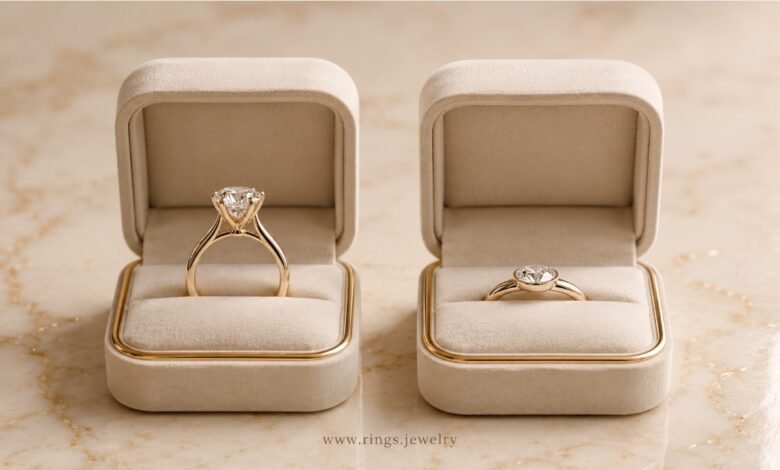
High profile and low profile engagement rings can look completely different on the hand, even when they use the same diamond shape, metal, and setting style. The difference is not just visual drama. It changes comfort, snagging, wedding band fit, diamond exposure, and how the ring behaves in ordinary life.
Think of this as the side-view test. From above, two rings may both look like elegant solitaires. From the side, one diamond might sit high in a lifted basket, while the other sits close to the finger in a lower, more grounded setting. That small engineering choice can decide whether the ring feels effortless or slightly demanding.
The best choice is not automatically high or low. It depends on the wearer’s lifestyle, how much height feels comfortable, whether a flush wedding band matters, and how much visual presence the buyer wants from the center stone.
Quick Answer: High Profile vs Low Profile Engagement Ring
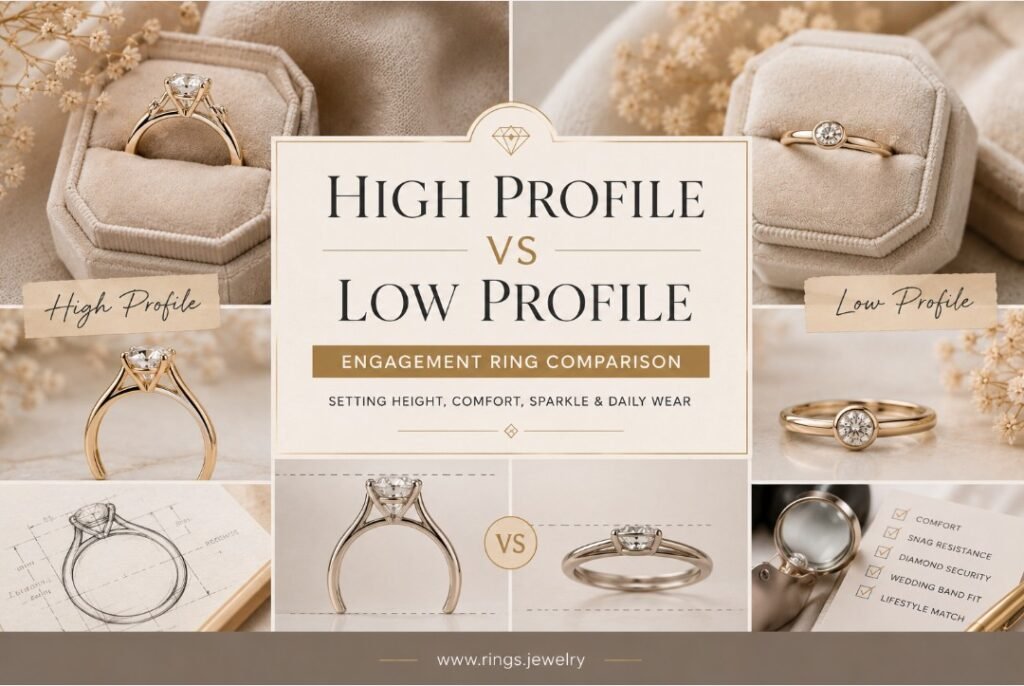
A high profile engagement ring lifts the center stone higher above the finger, which can make the diamond look more prominent and may help a straight wedding band sit closer to the engagement ring. A low profile engagement ring keeps the diamond closer to the hand, which usually feels more comfortable, catches less, and can be better for daily wear. High profile rings often suit buyers who want drama, height, and a traditional raised diamond look. Low profile rings often suit active lifestyles, practical wearers, and anyone who wants a ring that feels secure rather than delicate.
The Side View Tells You More Than the Top View
Most people shop for engagement rings from the top view. That makes sense at first: you see the diamond shape, the outline of the band, the sparkle pattern, and the overall style. But jewelers spend a lot of time looking from the side because the side view shows how the ring is built.
The side view reveals the profile height, basket depth, prong angle, gallery space, shoulder support, and how much of the diamond is exposed. It also hints at practical questions: Will this ring catch on a sweater? Will it feel tall on the hand? Can a wedding band sit beside it? Is the diamond protected enough for daily wear?
Bench check
When a ring comes across a jeweler’s bench, profile height is not judged as “pretty” or “not pretty.” We look at leverage, exposed edges, prong access, cleaning space, band contact, and whether the structure makes sense for the way the ring will be worn.
A high profile ring can be beautifully engineered. A low profile ring can be badly engineered. Height alone does not decide quality. But height does change how the whole design behaves, so it is one of the smartest details to compare before buying.
What a High Profile Engagement Ring Does Well
A high profile engagement ring raises the diamond above the band. This may happen through a cathedral setting, a tall basket, longer prongs, a raised peg head, or a design that leaves visible space between the center stone and the shank.
The appeal is obvious. The diamond gets presence. It looks lifted, important, and more visible from the side. If the buyer wants the center stone to be the star of the hand, a high profile ring can deliver that feeling with very little apology.
Where high profile rings often win
- Visual drama: the diamond stands higher and becomes more noticeable.
- Side visibility: more of the stone and setting architecture can be seen.
- Flush band potential: some raised settings allow a straight wedding band to tuck closer underneath.
- Classic bridal look: many traditional solitaire and cathedral styles use height to frame the diamond.
There is a reason high profile engagement rings remain popular. A lifted diamond can look graceful, especially with a round brilliant, oval, pear, cushion, or emerald cut stone. Height can make the ring feel more formal and ceremonial. It gives the setting a “stage.”
But a stage also sits above the floor.
The practical trade-off is exposure. A higher diamond is more likely to bump surfaces, catch on fabrics, and feel noticeable during daily movement. This does not mean it is unsafe. It means the design needs strong prongs, good support, and a wearer who is comfortable with a more elevated ring.
The hidden cost of height
A tall ring can make the diamond feel more dramatic, but it can also create more leverage when the ring is hit. Over time, repeated knocks can stress prongs or shift small details, especially in delicate settings.
What a Low Profile Engagement Ring Solves
A low profile engagement ring keeps the center stone closer to the finger. Instead of lifting the diamond high above the band, the setting pulls the design downward and makes the ring feel more integrated with the hand.
This is where low profile rings become quietly brilliant. They do not need to shout. They solve daily annoyances before they happen.
Less height usually means less snagging. The ring may slide into gloves more easily, feel calmer under sleeves, and avoid that constant “I need to protect this” feeling. For someone who works with their hands, travels often, has children, handles bags, or simply dislikes fussy jewelry, that comfort can matter more than a dramatic side view.
Where low profile rings often win
A low setting is usually the more practical choice when the ring will be worn every day and the wearer wants comfort, security, and fewer interruptions. It is especially useful for bezel settings, low baskets, east-west designs, and rings made for active lifestyles.
For a deeper look at this style on its own, see our guide to low profile engagement rings. That article focuses specifically on comfort, daily wear, secure settings, and how low designs behave over time.
The caution is that low does not always mean better. If the diamond sits too low, the ring may look compressed. The stone may lose visual lift. Cleaning access can become tighter. A straight wedding band may not sit flush. In other words, a low profile ring still needs intelligent architecture.
The Comfort Test: What You’ll Notice After the First Week
The first week with an engagement ring tells the truth. Not the showroom truth. The real one.
Does the ring catch when you put on a sweater? Does it spin because the top feels heavy? Do you tap it against counters? Does it feel natural when typing? Do you take it off to do simple things because it feels too exposed?
This is where profile height stops being a technical detail and becomes a daily habit.
More noticeable on the hand
A high profile ring may feel more present, more formal, and more dramatic. Some wearers love that feeling. Others become aware of the ring every time their hand moves near fabric, furniture, or hard surfaces.
Closer and calmer
A low profile ring usually feels more settled. It can be easier to wear without thinking about it, especially for someone who is not used to tall jewelry or wants a more practical engagement ring.
Comfort also depends on band width, ring size, shank shape, stone size, and how the weight is distributed. A large diamond in a high basket can feel top-heavy if the band is very thin. A low profile ring with a wide shank may feel stable but heavier between the fingers. The profile is one part of comfort, not the entire story.
Fitting-room advice
If possible, try on rings with different heights before choosing a setting. Many buyers discover they have a strong preference only after seeing how a high or low diamond feels during normal hand movement.
Does a High Profile Ring Sparkle More?
Not automatically.
This is one of the most common misunderstandings. A higher diamond may look more open from the side, and a raised setting can expose more of the stone. But diamond sparkle comes mainly from cut quality, proportions, polish, symmetry, cleanliness, and how light returns through the crown of the stone.
A high profile ring can make the diamond feel more visually lifted. A low profile ring can make the diamond feel more modern, smooth, and protected. Neither guarantees better sparkle by itself.
What actually affects sparkle
- Cut quality: especially important for round brilliant diamonds and other faceted shapes.
- Stone cleanliness: lotion and soap under the setting can dull even a beautiful diamond.
- Setting openness: more open settings may show more side light, but top performance still depends on the diamond.
- Metal and design: bezels, halos, prongs, and cathedral shoulders change how the stone is framed.
If the goal is maximum visible diamond and traditional sparkle, a high prong or cathedral setting may appeal. If the goal is a clean, secure, contemporary design, a lower basket or bezel may make more sense. Buyers comparing stone security and light exposure may also find our prong and bezel setting comparison useful before making a final choice.
The better question is not “which profile sparkles more?” It is “which profile gives this specific diamond the right balance of beauty and wearability?” A poorly cut diamond will not become magical because it sits higher. A well-cut diamond does not become dull simply because it sits lower.
Wedding Band Fit: The Detail That Changes Everything Later
Engagement ring height affects what happens when the wedding band enters the story.
A high profile setting often leaves more space below the center stone. That can make it easier for a straight wedding band to sit close to the engagement ring. This is one reason some buyers choose a raised basket or cathedral design: they want a clean, flush bridal set.
A low profile setting may not leave that same clearance. The center stone or basket can block a straight band from sitting flush. That does not make the ring wrong. It just means the wedding band needs to be planned differently.
Straighter band pairing
Some high settings allow a straight wedding band to sit neatly beside the engagement ring. This can be ideal for buyers who want a classic stacked look without a custom curve.
Contoured or nested band
Low settings may work better with a curved, contoured, open, or custom wedding band. The result can be beautiful, but it should be planned before the wedding band purchase.
One mistake we see often is buying the engagement ring first and treating the wedding band as a separate problem for later. It should not be completely separate. If the wearer wants a flush set, ask about band fit before approving the engagement ring design.
Ask this before buying
“Will a straight wedding band sit flush with this engagement ring, or will I need a curved, contoured, or custom band?” That one question can prevent a very annoying surprise months later.
The Lifestyle Match: Which Profile Fits the Wearer?
The right profile is less about trend and more about temperament. Some people love a ring that announces itself. Some people want a ring that quietly fits into their life. Neither person is wrong.
A high profile ring often suits someone who enjoys a more dramatic jewelry look, wants the diamond raised and visible, and does not mind being a little more careful. A low profile ring often suits someone who values comfort, practicality, and a design that does not interrupt daily movement.
High profile may suit you if…
- You want the diamond to feel elevated and prominent.
- You like traditional solitaire or cathedral silhouettes.
- You want a straight wedding band to have a better chance of sitting flush.
- You do not mind a ring that feels more noticeable on the hand.
- You are comfortable with occasional prong checks and careful wear.
Low profile may suit you if…
- You want the ring to sit closer to the finger.
- You dislike snagging on clothing, gloves, or bags.
- You prefer practical jewelry for daily wear.
- You are considering bezel, low basket, or east-west settings.
- You want a ring that feels secure and less delicate.
For the full buying process — from diamond shape and setting style to metal choice, budget, and long-term wear — use our expert guide to choosing an engagement ring as the broader starting point.
The Repair Bench View: What Can Go Wrong?
This is where the conversation gets less glamorous but more useful.
High profile rings can be more vulnerable to knocks because the stone sits higher. That does not mean they are fragile by default. A well-made cathedral setting with strong shoulders and properly finished prongs can be very durable. But tall settings often need the wearer to be more aware of impact, especially if the ring has delicate prongs or a large center stone.
Low profile rings can avoid many snagging problems, but they can have their own issues. If the setting is too tight, dirt can collect under the stone. If the diamond is too enclosed, the ring may be harder to clean. If the band cannot sit flush, the wearer may later need a custom wedding band or a spacer.
What we would inspect first
- Are the prongs thick enough for long-term wear?
- Is the diamond girdle protected or exposed?
- Does the basket have enough support?
- Will the setting trap dirt in hard-to-clean spaces?
- Can the wedding band sit safely beside the engagement ring?
- Does the ring feel top-heavy on the finger?
The best ring is not the one that looks perfect for five minutes in a showroom. It is the one that still makes sense after years of wear, cleaning, resizing questions, prong checks, and ordinary life.
High Profile vs Low Profile by Diamond Shape
Diamond shape changes how profile height feels. A round brilliant in a high setting may look classic and balanced. An elongated oval in a high setting may feel elegant but more exposed. An emerald cut in a low setting may look sleek and architectural. A marquise or pear shape may need careful tip protection no matter how high or low the ring sits.
Flexible with height
Round diamonds can work beautifully in both high and low settings. The deciding factors are usually comfort, wedding band fit, and whether the wearer wants a classic raised look.
Elegant but watch exposure
Elongated stones give strong finger coverage. In high settings, they can feel dramatic; in lower settings, they often look modern and easier to wear.
Clean and architectural
Emerald cuts can look especially refined in lower, more structured settings, but the design should not hide the crisp step-cut geometry.
Tip protection matters
Pear diamonds need thoughtful protection at the point. Height matters, but prong placement, bezel support, and setting security matter even more.
Stone size also changes the equation. A small or medium diamond can often sit higher without feeling overwhelming. A larger diamond may already have enough visual presence, so a lower setting can make it feel more wearable without reducing its impact.
The Jeweler’s Verdict: Choose the Profile You Can Actually Live With
A high profile engagement ring is usually the better choice if you want a lifted, dramatic diamond look, more side visibility, and a setting that may pair more easily with a straight wedding band. It can be beautiful, traditional, and elegant — as long as the wearer is comfortable with the extra height.
A low profile engagement ring is usually the better choice if comfort, daily wear, reduced snagging, and a secure feeling matter more than dramatic elevation. It is often the smarter option for active lifestyles and buyers who want a ring that feels natural on the hand.
Our practical recommendation is simple: do not choose profile height from a photo alone. Look at the ring from the side, ask how the wedding band will fit, check how exposed the diamond is, and think honestly about the person who will wear it every day. A ring can be breathtaking and still be wrong for someone’s life. The best design is the one that looks beautiful and behaves well.
FAQ
What is the difference between a high profile and low profile engagement ring?
A high profile engagement ring raises the center stone higher above the finger, while a low profile engagement ring keeps the stone closer to the hand. High profile rings usually look more dramatic. Low profile rings usually feel more practical for daily wear.
Is a high profile engagement ring better?
It can be better if you want the diamond to look lifted, prominent, and more visible from the side. High profile settings may also help some straight wedding bands sit closer to the engagement ring. The downside is that taller rings can catch more easily and may feel more exposed during everyday wear.
Is a low profile engagement ring better for daily wear?
Usually, yes. A low profile engagement ring often catches less on clothing, gloves, bags, and furniture because the center stone sits closer to the finger. It is a strong choice for active wearers, practical buyers, and people who want a ring that feels secure rather than delicate.
Do high profile rings sparkle more than low profile rings?
Not automatically. Sparkle depends more on diamond cut quality, proportions, polish, symmetry, and cleanliness than on profile height alone. A high setting may show more of the diamond from the side, but a well-cut diamond in a low setting can still look bright and lively.
Can a low profile engagement ring sit flush with a wedding band?
Sometimes, but not always. Because the center stone sits lower, there may not be enough space for a straight wedding band to slide underneath the setting. Some low profile rings pair better with curved, contoured, open, or custom wedding bands.
Are high profile engagement rings less secure?
Not necessarily. A well-made high profile ring can be secure if the prongs, basket, shoulders, and band are properly designed. However, because the diamond sits higher, the ring may be more exposed to bumps and snagging, so regular prong checks are important.
Who should choose a high profile engagement ring?
A high profile ring is a good choice for someone who loves a dramatic diamond look, wants the stone to feel elevated, and does not mind wearing a ring with more height. It can also suit buyers who want a classic cathedral or raised solitaire style.
Who should choose a low profile engagement ring?
A low profile ring is ideal for someone who wants comfort, daily wear practicality, reduced snagging, and a more grounded design. It works especially well for active lifestyles or anyone who does not want to think about protecting the ring constantly.
Do low profile rings make diamonds look smaller?
They can, depending on the setting. A very enclosed low setting may make the diamond look more framed and slightly less exposed. But the diamond shape, cut, band width, bezel thickness, and overall proportions matter more than profile height alone.
What should I ask before choosing high or low profile?
Ask whether the ring will catch easily, whether the center stone is well protected, whether a straight wedding band will sit flush, how easy the setting is to clean, and whether the height matches the wearer’s daily lifestyle.
