How Much Should You Spend on an Engagement Ring in 2026?
Engagement Ring Budget Guide 2026
The right engagement ring budget is not a salary formula, a social-media dare, or a number whispered by someone who bought a ring in a completely different diamond market ten years ago. In 2026, the smarter question is more practical: what amount gives you a ring your partner will love, that you can afford without financial tension, and that is made well enough to survive decades of real wear?
That answer can be $500. It can be $2,000. It can be $10,000 or more. The number matters, of course, but the order of priorities matters more: financial comfort first, beauty second, craftsmanship always. A spectacular ring that creates debt anxiety is not romantic. A modest ring with thoughtful proportions, a secure setting, and a stone chosen with care can feel infinitely more personal than an overpriced ring bought to satisfy an outdated rule.
Recent U.S. engagement ring cost surveys are not perfectly identical because they measure different buyers, ring types, and reporting methods. The Knot reported an average of $5,200 in its 2024 Jewelry & Engagement Study, while BriteCo’s 2025 appraisal-based research placed the average at $6,504; natural-diamond-focused reporting can land higher, such as $7,364 in 2025 natural diamond trends coverage. Treat these figures as context, not commandments.
Before you choose a budget, read our Engagement Rings guide to understand shapes, settings, metals, and diamond quality. A budget only works when you know what you are actually buying.
The practical answer
In 2026, many couples should think in ranges, not rules. A comfortable engagement ring budget is usually the amount you can pay without delaying essential savings, carrying high-interest debt, or compromising daily life. For many buyers, that means somewhere between $1,000 and $6,500; for luxury natural diamonds, custom work, antique stones, or larger center stones, the budget can rise sharply.
Is the Three-Month Salary Rule Still Relevant?
The three-month salary rule is mostly a marketing fossil with excellent survival instincts. It sounds simple, which is why it refuses to die: take your monthly income, multiply it by three, and buy a ring at that level. The problem is that engagement ring buying is not simple. Two people with the same income can have completely different rent, student loans, family obligations, savings goals, medical costs, wedding plans, and comfort with debt.
In a luxury jewelry context, we see the salary rule fail in both directions. Some clients can afford more than the rule suggests and choose less because they value restraint, old-money subtlety, or a future home more than a large center stone. Others want a rare natural diamond, an antique cut, a handmade platinum setting, or a sculptural custom design and knowingly spend more because jewelry is one of their shared priorities. Both can be correct. The rule is not the judge; the couple’s financial reality is.
The more modern approach is to build the budget backward. Start with what you can spend comfortably. Then decide what matters most: diamond size, natural origin, lab-grown value, hand fabrication, platinum, a designer setting, low profile wearability, future wedding band fit, or a particular shape. Only after that should you compare stones and settings.
A better rule for 2026: spend enough to buy a ring with sound craftsmanship, secure stone setting, and beauty your partner will actually enjoy wearing — but not enough to make the proposal financially stressful.
There is also an emotional trap inside the salary rule: it turns a symbol into a test. A ring should not become proof that someone “cares enough” to overspend. Good taste is not always expensive; poor judgment often is. A slightly smaller diamond with excellent proportions, a graceful setting, and a clean finish can look more refined than a larger stone with awkward shoulders, cloudy transparency, or prongs that look like they were installed during a minor earthquake.
Average Engagement Ring Cost
The average engagement ring cost in the United States is commonly reported in the mid-thousands, but the exact number depends on the study. The Knot’s recent survey placed the average at $5,200, BriteCo’s 2025 appraisal data placed it at $6,504, and natural-diamond-specific trend reporting has shown higher averages for that segment.
That does not mean you “should” spend $5,200, $6,504, or $7,364. Averages are heavily influenced by luxury purchases. A $25,000 ring and a $1,500 ring do not describe the typical emotional experience of buying a ring; they simply meet in the spreadsheet and pretend to be one person.
For practical buying, it is better to think in bands:
Best for simple gold bands, petite diamonds, moissanite, minimalist settings, vintage finds, or a temporary “proposal now, upgrade later” ring.
A strong value range for small natural diamonds, larger lab-grown diamonds, elegant solitaires, bezel settings, and thoughtful everyday rings.
One of the most flexible ranges: quality lab-grown center stones, modest natural diamonds, platinum options, three-stone designs, and better craftsmanship.
Comfortable territory for larger lab-grown diamonds, finer natural diamonds, custom design, premium settings, and more selective stone quality.
Luxury natural diamonds, rare shapes, antique stones, high-carat designs, handmade settings, platinum craftsmanship, and bespoke work with fewer compromises.
The median buyer may spend less than headline averages suggest, especially if they choose lab-grown diamonds, moissanite, colored gemstones, lower-carat natural diamonds, or simpler settings. Meanwhile, clients buying natural diamonds with premium cut quality, high color and clarity, or larger carat weights can exceed national averages quickly.
A good engagement ring price guide for 2026 should not shame modest budgets or romanticize overspending. It should help you understand what each range realistically buys — and where to avoid false economy.
What Affects the Price?
The center stone usually drives the largest part of the engagement ring cost, but it is not the only factor. A buyer who focuses only on carat weight can accidentally ignore the parts that make the ring beautiful, durable, and comfortable.
Diamond or gemstone type is the first major price divider. Natural diamonds remain more expensive than lab-grown diamonds of similar size and visible quality. Lab-grown diamonds have made larger stones accessible at lower budgets, but they do not behave the same in resale value or rarity. Moissanite is usually less expensive than diamond and can be visually impressive, though its brilliance has a different character. Colored gemstones vary wildly: sapphire can be durable and elegant, emerald is beautiful but more delicate, and softer stones may not be ideal for daily wear.
Carat weight affects price sharply, especially at psychological milestones such as 1.00 ct, 1.50 ct, 2.00 ct, and above. A 0.90 ct diamond can look very close to a 1.00 ct diamond on the hand, but the price may be noticeably lower. This is one of the simplest ways to save without making the ring look “small.”
Cut quality is where many buyers should protect the budget fiercely. A diamond with excellent proportions, lively light return, and good symmetry can appear brighter and more impressive than a larger but duller stone. On paper, size feels measurable. On the hand, sparkle wins arguments.
Expert note: If you must compromise, usually compromise first on carat milestone, then on color within reason, then on clarity if the stone is eye-clean. Be very cautious about compromising on cut, setting security, or metal durability.
Color and clarity influence price, but they should be judged intelligently. Many diamonds do not need to be D color or flawless to look beautiful. Near-colorless grades can be excellent choices, especially in yellow gold or rose gold. Eye-clean clarity is often more important than a high clarity grade that no one can appreciate without magnification.
Shape also matters. Round brilliant diamonds often command higher prices because of demand and cutting loss. Fancy shapes such as oval, pear, radiant, cushion, emerald, and marquise can sometimes give more visual spread for the money, though each shape has its own quality traps: bow-tie shadows in elongated cuts, windowing in step cuts, crushed-ice appearance in certain cushions and radiants, or fragile points in pear and marquise shapes.
Metal choice changes the final price and long-term maintenance. Platinum is dense, prestigious, and durable, but more expensive and heavier. 18k gold has rich color but is softer than 14k gold. 14k gold can be highly practical for daily wear, especially for delicate designs. White gold usually requires rhodium maintenance over time if the wearer wants a bright white finish.
Setting complexity can quietly transform the budget. A clean solitaire is usually more affordable than pavé, hidden halos, three-stone designs, halos, cathedral shoulders, or custom gallery work. Tiny diamonds are not “free decoration.” They require cutting, matching, setting, labor, and future maintenance. Pavé can be gorgeous, but cheap pavé is one of the fastest ways to turn a romantic purchase into a repair conversation.
Craftsmanship is the least glamorous factor until the ring starts snagging sweaters, losing stones, bending prongs, or refusing to sit flush with the wedding band. Look at prong symmetry, stone height, shank thickness, gallery support, polish quality, and whether the setting is appropriate for the center stone’s shape. A ring is not only an object for the proposal photo; it is a miniature piece of engineering worn on a moving hand.
Budget Examples
Budget examples are more useful than averages because they show trade-offs. Here is what different budgets can realistically prioritize in 2026 without pretending every buyer wants the same ring.
This budget works best for a refined promise-style ring, a petite diamond accent ring, a simple gold band with symbolic detail, moissanite, or a vintage-inspired design. Avoid overly complicated settings at this price; complexity often means compromises in metal weight, stone setting, or finish.
At $1,000, focus on simplicity and intention. A small natural diamond solitaire, a lab-grown diamond under one carat, a moissanite center stone, or a bezel-set minimalist ring can look elegant. Choose clean proportions over maximum size.
This is a strong practical range for a quality lab-grown diamond, a smaller natural diamond with better cut, or a simple custom-feeling setting. You can begin to care more about metal choice and setting refinement, not only the stone.
At $5,000, you can make a beautiful ring with fewer compromises: a sizable lab-grown diamond, a modest but well-selected natural diamond, a platinum or higher-quality gold setting, or a three-stone design with real presence.
This range opens the door to luxury natural diamonds, larger center stones, antique diamonds, excellent custom work, sculptural settings, and more selective diamond quality. The danger here is not lack of options — it is paying more without understanding why.
For a $500 to $1,000 budget, the best strategy is restraint. Avoid trying to imitate a $7,000 ring with thinner metal, lower setting quality, and questionable stones. A simple ring that knows exactly what it is will look far better than a complicated ring pretending to be more expensive.
For $2,000 to $5,000, you can start building a serious engagement ring. This is where lab-grown diamonds become especially attractive, because the same budget may buy a visibly larger or higher-quality center stone. If choosing natural, think carefully about carat weight and cut: a beautifully cut smaller stone can feel more luxurious than a larger diamond with sleepy light performance.
At $10,000 and beyond, the buying process should become more selective, not more impulsive. Ask for certification, compare stones under different lighting, understand fluorescence, inspect inclusion placement, review the setting CAD or design details, and consider how the ring will pair with a wedding band. More money should buy better judgment, not only a larger number on the grading report.
Best Ring Options Under $1,000
An engagement ring under $1,000 can be beautiful if the design is honest. The mistake is expecting this budget to do everything: large center stone, natural diamond, ornate pavé, platinum, custom setting, and flawless finish. Something has to give. The art is choosing what gives without losing charm.
The strongest options under $1,000 are usually minimalist solitaires, petite bezel rings, moissanite center stones, small lab-grown diamonds, vintage-inspired bands, or low-profile rings with subtle detail. A 14k gold setting is often more realistic than platinum here. Yellow gold can also help warmer or lower-color stones look intentional rather than compromised.
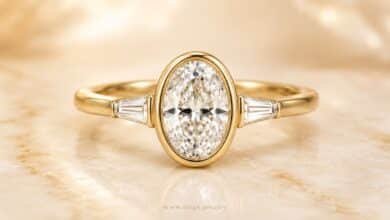
A bezel setting can be a particularly smart choice in this range. It frames a smaller stone beautifully, protects the edges, and gives the ring a finished architectural presence. A tiny diamond in a well-proportioned bezel can look chic, almost Parisian, while a poorly made halo trying to fake size can look nervous.
Workshop detail: Under $1,000, check metal thickness carefully. Extremely thin shanks may look delicate in photos, but they can bend, distort, or wear down faster. A ring worn daily needs enough structure to survive a real hand, not just a product page.
Moissanite is also worth considering if size and brilliance matter more than diamond identity. It is durable enough for daily wear and can create a striking look at a modest price. The visual character is different from diamond — often more rainbow fire — so it should be chosen knowingly, not as a secret substitute.
Small lab-grown diamonds can work beautifully for buyers who want a diamond but do not need a large stone. The key is to avoid spending the entire budget on the center stone and leaving nothing for the setting. A secure, well-finished setting is not decoration; it is the ring’s foundation.
Avoid ultra-cheap pavé, mystery metal descriptions, vague stone information, and rings that hide poor construction behind heavy photo editing. If the ring looks too elaborate for the price, ask yourself where the cost was removed. Usually it was removed from labor, metal weight, stone quality, or all three.
Best Ring Options Under $2,500
Under $2,500 is one of the most interesting engagement ring budget ranges in 2026 because it allows genuine choice. You can choose a tasteful natural diamond ring, a more impressive lab-grown diamond, a high-quality moissanite design, or a setting with enough refinement to feel personal rather than generic.
For natural diamonds, this budget often works best when you avoid chasing a full one-carat milestone. A 0.50 to 0.90 ct natural diamond with excellent cut can be elegant, especially in a solitaire, bezel, or delicate three-stone layout. If the wearer has smaller hands or prefers understated jewelry, this can be more than enough.
For lab-grown diamonds, $2,500 can create a much larger look. Depending on market pricing and setting choice, buyers may find attractive lab-grown center stones around or above one carat, sometimes more. The exact size should still be secondary to cut quality, proportions, and whether the stone looks lively in motion.
This budget also gives room for design personality. A tapered band can make a center stone appear more prominent. A cathedral setting can add structure and lift. A bezel can make the ring feel modern and secure. A hidden halo can add private sparkle, though it should not weaken the setting or make cleaning unnecessarily difficult.
At this price, the best ring is usually not the biggest ring. It is the ring where the stone, setting, metal, and hand all seem to belong to the same sentence.
If your partner wants a classic diamond engagement ring, this budget is enough to buy something sincere and lasting. If your partner dreams of a large oval or radiant, lab-grown may be the better route. If they love antique character, consider vintage settings or old-cut-inspired designs, but inspect condition carefully: worn prongs, thin shanks, and previous resizing can add repair costs.
One practical warning: do not let side stones consume the budget if the center stone is the priority. A ring with a modest but excellent center stone often ages better than a ring that spreads cost across too many small details.
Best Ring Options Under $5,000
Under $5,000 is where an engagement ring can feel genuinely luxurious with smart decisions. This range can support a beautiful lab-grown diamond ring with presence, a natural diamond ring with restraint and quality, or a custom design that does not feel stripped down.
If choosing lab-grown, this budget can often deliver a larger center stone with strong visual impact. Oval, radiant, emerald, cushion, pear, and round brilliant shapes are all realistic options depending on quality and setting. But bigger is not automatically better. Large lab-grown diamonds with poor proportions, visible windowing, dull centers, or awkward bow-ties still look disappointing. Size gives drama; cut gives life.
If choosing natural diamond, $5,000 can buy a refined ring if you prioritize intelligently. You may choose a slightly smaller diamond with excellent cut, a near-colorless grade, and eye-clean clarity. You might also consider fancy shapes for better visual spread, or a yellow gold setting to make a warmer diamond look harmonious.
This is also a good budget for settings that deserve respect: a well-made solitaire with graceful prongs, a bezel with clean edges, a three-stone ring with balanced side stones, or a pavé band where the tiny stones are actually set with care. Good pavé should look crisp, not lumpy. Prongs should be neat, not bulky. The center stone should sit securely, not perched like it is considering escape.
Common $5,000 mistake: spending nearly everything on the center diamond and choosing the cheapest possible setting. A weak setting can make an expensive stone look less refined — and can create maintenance problems later.
At this level, ask about wedding band fit before buying. Many buyers fall in love with a low-profile setting, then discover a straight wedding band cannot sit flush. That is not always a problem; some people love a gap or a curved band. But it should be a choice, not a surprise six months later.
Also think about lifestyle. A high-set ring may look dramatic, but it can snag more easily. A delicate pavé band may be romantic, but not ideal for someone hard on jewelry. A bezel may be less airy than prongs, but it can be excellent for active wear. The best $5,000 ring is not only beautiful in a velvet box. It is beautiful on Tuesday, after coffee, keys, hand cream, errands, and real life.
When to Choose Lab-Grown
Lab-grown diamonds are one of the biggest reasons engagement ring budgeting has changed. They allow buyers to access larger diamond sizes or higher visible quality for less than comparable natural diamonds. For many couples, that is not a compromise; it is exactly the point.
Choose lab-grown if your partner wants a larger diamond look, if you care more about visible beauty than geological rarity, if your budget is fixed but you want more presence, or if you prefer to direct money toward the setting, wedding, travel, home, or savings. Lab-grown can be especially compelling for elongated ovals, radiants, emerald cuts, cushions, and larger solitaires where finger coverage is a major part of the desired look.
Choose natural diamond if rarity, tradition, long-term market perception, heirloom psychology, or natural origin matters deeply to you or your partner. Natural diamonds still carry a different emotional and cultural weight for many buyers. Whether that matters is personal; pretending it does not matter to anyone is as silly as pretending it must matter to everyone.
The most important rule is transparency. Never buy lab-grown while implying it is natural. Never buy natural while assuming it is automatically better-looking. Compare actual stones, not ideology. A superb lab-grown diamond can be visually stunning. A poorly chosen natural diamond can be dull. A rare natural diamond can be extraordinary. A cheap lab-grown diamond can still be badly cut.
Lab-grown makes sense when:
You want more size for the budget, prefer a modern value equation, are comfortable with lower resale expectations, and care most about the ring’s look on the hand.
Natural makes sense when:
You value geological rarity, tradition, heirloom symbolism, and the emotional story of a diamond formed naturally over immense time.
For budget planning, lab-grown often lets you shift money toward better craftsmanship. That can be a wise move. A beautiful diamond in a flimsy setting is like a couture gown hemmed with office tape. The center stone may be the star, but the construction decides whether the performance lasts.
Certification still matters for lab-grown diamonds. Review cut, color, clarity, measurements, growth method when available, fluorescence or treatment disclosures, and the stone’s actual appearance. For fancy shapes, videos and in-person viewing are especially useful because two stones with similar grades can look completely different.
How to Save Without Losing Beauty
Saving money on an engagement ring does not mean making it look cheaper. The best savings are invisible to everyone except the person paying the invoice.
First, buy just under major carat milestones. A 0.90 ct diamond can look close to a 1.00 ct diamond, especially when well cut, but it may cost less. The same logic can apply near 1.50 ct and 2.00 ct marks. The eye sees diameter and sparkle before it sees the grading report’s emotional baggage.
Second, prioritize cut over unnecessary perfection in color and clarity. Many buyers pay for clarity grades they cannot see. If a diamond is eye-clean and the inclusions are not durability risks, you may not need a high clarity grade. Likewise, near-colorless diamonds can look excellent, especially in warm metal settings.
Third, choose the setting strategically. A solitaire is not boring when the proportions are right. A tapered shank, elegant claw prongs, a compass setting, or a well-shaped basket can add sophistication without the cost and maintenance of heavy pavé. If you do choose pavé, choose quality over quantity.
Fourth, consider fancy shapes. Ovals, pears, marquise, and emerald cuts can offer strong finger presence, though each requires careful selection. Do not buy fancy shapes from certificate numbers alone. Look for bow-tie severity, symmetry, length-to-width ratio, windowing, and whether the stone has pleasing life under normal light.
Fifth, think about metal honestly. Platinum is beautiful and prestigious, but 14k or 18k gold may be the better budget choice for many designs. Yellow gold can make a slightly warmer diamond look intentional. Rose gold can soften the overall look. White gold is bright and classic, but remember rhodium maintenance over time.
Sixth, avoid overpaying for features your partner does not care about. If they love minimalist jewelry, do not spend extra on a hidden halo. If they want a low-maintenance ring, do not choose delicate pavé down three sides of the shank. If they adore antique romance, do not force a hyper-modern round brilliant solitaire because it seems “safe.”
The quiet luxury approach: spend on proportion, finish, comfort, and stone selection. Save on invisible grade inflation, unnecessary carat milestones, and decorative complexity that does not improve the ring on the hand.
Finally, leave room in the budget for practical costs. Resizing, insurance, appraisal, wedding band pairing, future maintenance, prong checks, polishing, and cleaning all belong to the real cost of ownership. A ring is not finished the day it is purchased. It enters a long relationship with hands, habits, fabrics, countertops, luggage, lotion, and time.
The best engagement ring budget in 2026 is not the highest number you can survive. It is the amount that lets you buy with confidence, choose with taste, and propose without a private financial panic playing in the background.
Final guidance
Spend what feels generous but sane. If that is $1,000, make it elegant and durable. If it is $5,000, balance stone quality with setting quality. If it is $10,000 or more, demand craftsmanship worthy of the price. The ring should feel like a promise, not a performance invoice.
FAQ
How much should you spend on an engagement ring in 2026?
You should spend an amount that fits your finances comfortably. Many buyers fall between $1,000 and $6,500, but the right budget depends on income, savings, debt, partner expectations, stone choice, and setting quality.
Is the three-month salary rule still used for engagement rings?
Some people still mention it, but it is outdated. A better approach is to choose a budget based on financial comfort, lifestyle, ring quality, and what your partner actually wants.
What is the average engagement ring cost in 2026?
Recent U.S. averages commonly land in the mid-thousands, often around $5,000 to $7,000 depending on the survey and whether lab-grown, natural diamond, or appraisal-based data is measured.
Can I buy a good engagement ring under $1,000?
Yes. Under $1,000, focus on simple designs, petite diamonds, moissanite, small lab-grown diamonds, bezel settings, or minimalist gold rings. Avoid overly complex settings with weak construction.
Is $2,500 enough for an engagement ring?
Yes. A $2,500 budget can buy a beautiful lab-grown diamond ring, a smaller natural diamond ring, moissanite, or a refined simple setting with good craftsmanship.
What engagement ring budget gives the best value?
For many buyers, $2,000 to $5,000 offers the strongest balance of beauty, quality, and flexibility. Lab-grown diamonds especially expand options in this range.
Should I choose lab-grown to save money?
Lab-grown diamonds are a smart choice if you want a larger or higher-quality-looking diamond for the budget and are comfortable with lower resale expectations compared with natural diamonds.
What should I not sacrifice when buying an engagement ring?
Do not sacrifice cut quality, setting security, prong quality, metal durability, or comfort. These affect how the ring looks, wears, and survives daily use.
Is a natural diamond worth the higher price?
A natural diamond can be worth it if rarity, tradition, heirloom value, and natural origin matter to you. If visual size and value matter more, lab-grown may be the better choice.
How can I save money without making the ring look cheap?
Buy slightly below major carat milestones, choose eye-clean clarity, consider near-colorless stones, use yellow gold for warmer diamonds, avoid unnecessary pavé, and prioritize excellent proportions.