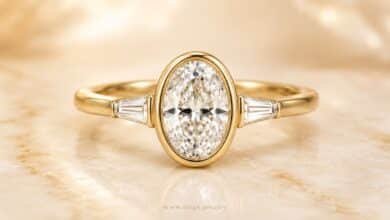
East-West Engagement Rings: The Modern Setting Everyone Is Talking About
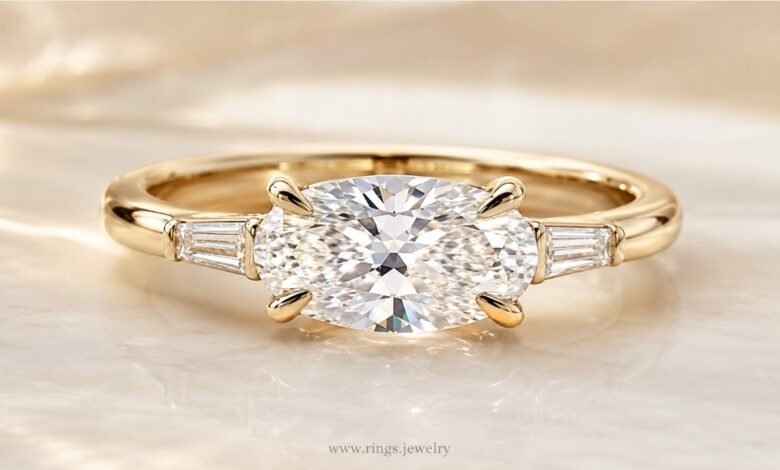
Modern Setting Guide
An east-west engagement ring does one small thing that changes the entire attitude of the ring: it turns the center stone sideways. That is it. No fireworks, no architectural gymnastics, no secret mechanism. Yet the result can feel completely different — more modern, more fashion-aware, more relaxed, and often more personal than the traditional north-south setting.
Instead of pointing up and down the finger, the diamond stretches across it. An oval becomes softer and more unexpected. An emerald cut becomes architectural. A marquise turns into a slim flash of light. A cushion becomes quietly offbeat. A bezel makes the whole thing feel like a tiny piece of modernist design rather than a conventional bridal ring.
East-west engagement rings are not for every bride or every hand. They are not automatically better than classic settings. But when the stone, setting height, band width, and finger proportions are handled well, this style has a rare quality: it looks current without needing to shout that it is current.
For a broader look at ring styles, start with our Engagement Rings guide.
What Is an East-West Engagement Ring?
An east-west engagement ring is a ring where the center stone is set horizontally across the finger instead of vertically along it. In a traditional north-south setting, an oval, emerald cut, pear, marquise, or cushion usually points from knuckle to fingertip. In an east-west setting, the same stone is rotated sideways, so its longest line runs left to right.
This orientation changes the ring’s silhouette immediately. A classic oval no longer feels like the expected bridal oval. An emerald cut becomes cleaner and more graphic. A marquise looks less dramatic in the old-fashioned sense and more like a sleek slash of light. Even a cushion can become more interesting when the proportions are elongated and the setting is kept low.
Most east-west rings use elongated shapes because the horizontal direction needs something to emphasize. Round diamonds can technically be used in an east-west-inspired design, but the orientation does not matter much because a round diamond has no long axis. The style comes alive with stones that have length: oval, emerald cut, radiant, marquise, pear, elongated cushion, and sometimes Asscher-like shapes used in more creative layouts.
Design note: East-west is not a diamond shape. It is a setting direction. The same oval diamond can feel classic north-south, modern east-west, or architectural in an east-west bezel.
The setting can be prong-set, bezel-set, half-bezel, tension-inspired, low-profile, cathedral, solitaire, three-stone, or integrated into a wider band. But the best east-west rings usually avoid too many competing ideas. Since the orientation is already the visual twist, the surrounding design should support it rather than fight for attention.
A strong east-west ring has balance. The stone should not look accidentally turned sideways. The prongs or bezel should make the orientation feel deliberate. The band should meet the stone naturally. The ring should sit comfortably without spinning, tilting, or catching constantly. The design may look effortless, but the construction needs to be very intentional.
Why This Setting Is Trending
East-west engagement rings are trending because they answer a very specific modern desire: people want engagement rings that still feel bridal, but not identical to every ring they have already seen. The east-west setting keeps the familiar ingredients — diamond, precious metal, center stone, commitment symbolism — and rearranges them just enough to feel fresh.
Fashion has also moved toward horizontal lines, sculptural jewelry, wider bands, bezels, yellow gold, antique cuts, and designs that feel chosen rather than copied. East-west settings sit comfortably inside that mood. They do not need a halo or heavy pavé to look interesting. The orientation itself creates the visual point.
Celebrity rings helped accelerate the conversation. When a distinctive ring appears on a high-profile hand, buyers start asking why it looks different. But celebrity influence alone does not make a design wearable. The reason east-west rings are staying in the conversation is that they offer real design advantages: lower profiles, strong finger coverage, modern geometry, and a less traditional bridal tone.
There is also a practical reason buyers like them. A horizontally set diamond can give noticeable finger coverage without requiring extreme carat weight. An east-west oval, marquise, or emerald cut can spread across the finger in a flattering way. This can make the ring feel visually substantial while staying sleek.
The east-west setting is not loud. It is sideways — and sometimes that is enough to make the whole ring feel newly intelligent.
Another reason this style feels current is that it is less formal. A north-south oval solitaire can read very bridal, very classic, very expected. Turn the oval horizontally, and suddenly the ring feels closer to fine jewelry — something with a point of view, not only a proposal script. That difference matters to people who want an engagement ring they would choose as jewelry even if it were not an engagement ring.
The risk, of course, is trend fatigue. A style that feels very 2026 may eventually announce its era. That is not automatically bad. Many beloved jewelry styles are tied to their moments. The question is whether the ring has enough proportion, craftsmanship, and personal relevance to age gracefully after the trend cycle moves on.
Best Diamond Shapes for East-West Rings
The best diamond shapes for east-west rings are shapes with a clear length-to-width relationship. The orientation needs to matter. If the stone is too round, too square, or too visually neutral, the east-west effect becomes weak.
Oval diamonds are the most popular entry point. They are romantic, flattering, and familiar enough that the horizontal setting feels modern without becoming difficult. An east-west oval engagement ring works especially well when the oval is not too long and narrow. A very elongated oval set sideways can stretch dramatically across the finger, which some people love, but it may feel less balanced on smaller hands.
Emerald cuts are excellent for east-west settings because their geometry becomes more architectural when rotated horizontally. The long step facets create broad flashes of light across the hand. An east-west emerald cut ring can feel restrained, expensive, and almost gallery-like. The main caution is clarity and windowing: step cuts reveal more, so the stone must be chosen carefully.
Marquise diamonds may be the most dramatic east-west choice. Traditionally, marquise diamonds point vertically and lengthen the finger. Set horizontally, they become sharp, sleek, and unexpected. The result can be beautiful, but it needs protection at both points. V-prongs, a bezel, or a carefully designed setting are not optional details; they are part of the survival plan.
Radiant cuts can work well when the stone is elongated and lively. An east-west radiant has more sparkle than an emerald cut and a stronger rectangular outline than an oval. It is a good option for someone who wants modern brilliance without the softness of an oval. Watch for overly crushed or chaotic faceting, especially in larger stones.
Elongated cushion cuts can be very attractive in east-west settings, particularly when the ring has antique or soft modern styling. A cushion set sideways feels less expected than an oval but less severe than an emerald cut. Antique cushions and old mine-inspired stones can look especially compelling in yellow gold or bezel settings.
Pear shapes are more complicated. A pear set east-west can look artistic and unusual, but the asymmetry is more obvious. The point can face left or right, and that choice changes the ring’s personality. It can be stunning for someone who likes directional design. It is not the safest choice for someone who wants quiet timelessness.
East-west oval. Romantic, wearable, and the easiest version for many buyers to love long-term.
East-west emerald cut. Clean, calm, graphic, and best when the diamond is beautifully transparent.
East-west marquise. Striking and fashion-forward, but points need excellent protection.
When comparing shapes, do not judge only the top view. East-west rings are highly dependent on profile. A stone that looks elegant from above may sit too high from the side. A bezel that looks sleek in a photo may feel bulky in person. A long stone may look glamorous until it bumps neighboring fingers. Shape choice is not only about beauty; it is also about how the ring lives on the hand.
East-West Bezel Rings
East-west bezel engagement rings are where the trend becomes most design-forward. A bezel setting wraps a narrow rim of metal around the edge of the stone. When the stone is horizontal, that rim creates a clean outline across the finger, almost like a miniature frame.
This combination works because the bezel makes the sideways orientation look intentional. Without a bezel, some east-west settings can read as a classic ring with the stone turned. With a bezel, the design becomes a complete object. The metal line, stone shape, and finger coverage all work together.
East-west bezels are also practical. They reduce snagging, protect stone edges, and often allow a lower profile. That makes them appealing for people who want an engagement ring they can wear daily without feeling constantly aware of prongs. They are especially good for emerald cuts, ovals, elongated cushions, marquise diamonds, and some radiant cuts.
The bezel must be made with precision. A thick, uneven bezel can make the diamond look smaller or trapped. A refined bezel should be even, smooth, and shaped to the stone. The rim should protect the diamond without swallowing it. The gallery should be clean. The band should flow into the setting rather than appear welded on as an afterthought.
Bench detail: In an east-west bezel, the horizontal line exaggerates any unevenness. If the bezel edge waves, dips, or looks heavier on one side, the eye notices immediately.
Metal choice changes the mood. Yellow gold makes an east-west bezel feel warmer and more vintage-modern. Platinum makes it cooler and more architectural. White gold gives a bright contemporary look but may require rhodium maintenance. Rose gold can be beautiful, though it may make the design feel more romantic and less crisp.
One detail to check is the wedding band fit. Some east-west bezels sit low and wide, which can make a straight wedding band difficult to wear flush. This is not a flaw if planned properly. A small gap can look chic, and a custom curved band can be elegant. But the buyer should know before the wedding band shopping begins.
If you want the cleanest possible version of the trend, an east-west bezel is probably it. It has fewer moving parts visually. It looks intentional. It wears well. It can be modern without relying on delicate pavé or extra decoration.
East-West Oval Rings
The east-west oval engagement ring is the friendly version of the trend. It still feels romantic. It still has the softness people love about ovals. But turning the stone sideways removes the overly familiar “classic oval solitaire” feeling and gives the ring a quieter fashion edge.
An east-west oval can be prong-set, bezel-set, half-bezel, or integrated into a wider band. The best choice depends on how bold the wearer wants the ring to feel. A prong-set east-west oval on a slim band is delicate and modern. A bezel-set oval is cleaner and more architectural. A wider band makes the ring feel more like fine jewelry and less like traditional bridal.
Proportion matters intensely. If the oval is too elongated, the ring may stretch too far across the finger. If it is too short and rounded, the east-west effect becomes less noticeable. Many beautiful east-west ovals sit in a middle range: elongated enough to feel horizontal, but not so long that the ring looks like a small canoe with commitment issues.
Bow-tie effect also matters. Ovals often show some shadow across the center. In an east-west setting, that shadow may read differently because the stone is rotated. Look at the diamond in motion, not only in a still photo. A little contrast can give life; a heavy dark bow-tie can make the center look split.
An east-west oval is especially strong for someone who likes current engagement ring trends but still wants softness. It is less severe than an emerald cut, less sharp than a marquise, and less unusual than an east-west pear. It gives modernity without asking the wearer to become a design manifesto.
Buying tip: For an east-west oval, ask to see the ring or stone on a hand with a similar finger size. Horizontal spread can be flattering, but scale changes dramatically from one hand to another.
Yellow gold is particularly attractive with east-west ovals because it emphasizes warmth and romance. Platinum or white gold makes the shape feel more crisp. A bezel in yellow gold leans vintage-modern; claw prongs in platinum lean refined and minimal. The same oval can tell very different stories depending on the metal and setting style.
East-West Emerald Cut Rings
East-west emerald cut rings are for people who like restraint with a sharp edge. An emerald cut is already less sparkly and more controlled than a round brilliant or oval. Turn it horizontally, and the ring becomes even more architectural. It feels clean, composed, and quietly expensive when done well.
The broad facets of an emerald cut create flashes rather than glitter. In an east-west setting, those flashes move across the finger. This can be beautiful, but it also means quality is exposed. Emerald cuts are honest stones. They do not hide inclusions, poor symmetry, or windowing politely. If something is wrong, they put it in a glass case.
Clarity is more important with emerald cuts than with many brilliant cuts. You do not necessarily need a flawless diamond, but you do need a stone that appears clean to the eye. Inclusion placement matters. A small inclusion near the edge may be acceptable; a visible mark in the open center may bother the wearer forever.
Length-to-width ratio is also important. A very long emerald cut set east-west can look dramatic but may feel wide on the finger. A shorter emerald cut may feel more balanced but less striking. The band width should support the stone. Too thin a band can make the ring look top-heavy; too thick a band can make the diamond feel embedded rather than featured.
Best for:
Minimalist style, architectural jewelry, low-profile settings, bezel designs, and buyers who prefer quiet flashes over intense sparkle.
Watch carefully:
Windowing, visible inclusions, uneven steps, overly wide spread, and settings that block too much of the stone’s elegant outline.
An east-west emerald cut bezel can be magnificent. It has the calm of a signet ring, the refinement of a step-cut diamond, and the modernity of a horizontal setting. In yellow gold, it becomes warmer and more vintage. In platinum, it becomes cooler and more gallery-like. In a wider band, it begins to feel almost sculptural.
This is not the best choice for someone who wants maximum sparkle. It is the best choice for someone who understands that luxury can be quiet. An east-west emerald cut ring does not beg for attention. It expects good lighting and good taste to do their jobs.
Is It Timeless or Too Trendy?
An east-west engagement ring is both timeless and trendy, depending on how it is designed. The orientation is having a strong trend moment, but horizontal stone settings are not new. Jewelers have used sideways stones, signet-style settings, antique-inspired bezels, and horizontal layouts for generations. What feels new is the current popularity and the way the style is being paired with ovals, bezels, chunky gold bands, and celebrity-driven design references.
If you want the most timeless version, keep the ring simple. Choose a classic diamond shape, a balanced proportion, a clean solitaire or bezel, and a metal your partner already loves. Avoid stacking every 2026 detail into one ring: oversized lab-grown oval, chunky yellow gold band, east-west orientation, hidden halo, sculptural bezel, pavé everywhere, and a wedding band plan no one has thought about. A ring can only carry so many trends before it starts limping.
For longevity, proportion is more important than novelty. A beautifully balanced east-west oval solitaire can age well. A clean emerald cut bezel can age beautifully. A dramatic marquise on a very trend-specific band may still be loved forever by the right person, but it announces its design moment more clearly.
The question is not only “Will this be trendy later?” The better question is “Will the wearer still enjoy the line, comfort, scale, and personality of this ring after the online conversation moves on?” If the answer is yes, the trend label becomes less important.
Longevity warning: Do not choose east-west only because it is being talked about. Choose it because the horizontal silhouette genuinely suits the wearer’s style, hand, and jewelry wardrobe.
One way to test timelessness is to imagine the ring without the trend language. Do you still like it if no one calls it “modern”? Do you still like it if celebrity rings disappear from the conversation? Do you still like it next to a plain wedding band? If yes, the ring has a better chance of lasting emotionally.
Another way is to reduce the design to its essentials. A strong east-west ring should still look good as a drawing: stone shape, band line, setting outline. If the basic silhouette is elegant, the ring has a foundation. If it relies entirely on hype, styling, or photography, be cautious.
Who Should Choose This Style?
An east-west engagement ring is best for someone who wants a ring that feels bridal but not conventional. It suits a wearer who likes clean design, fashion jewelry, modern heirlooms, low-profile settings, elongated shapes, and pieces that feel slightly unexpected without being theatrical.
It is a strong choice for someone who already wears jewelry with character: signet rings, sculptural bands, vintage gold, bezel-set stones, stackable rings, or minimal pieces with unusual proportions. If their wardrobe leans toward tailored basics, black silk, architectural coats, vintage denim, gold hoops, or quiet luxury with one sharp detail, east-west may make sense.
It is also good for buyers who want finger coverage without the traditional vertical look. An east-west oval, emerald cut, or marquise can create a wide visual line across the finger. This can be flattering, especially on longer fingers or hands that can carry horizontal scale. On very small hands, the proportions need more care.
Who should hesitate? Someone who has always imagined a classic solitaire may find east-west interesting now but too specific later. Someone who wants maximum sparkle may prefer a traditional round or oval orientation. Someone who wants the ring to pair perfectly with any straight wedding band should check the profile before buying. Someone who dislikes trend-sensitive design should choose the simplest possible version or stay with a classic setting.
The best candidates for east-west rings usually have one thing in common: they do not want their engagement ring to look like a default setting. They want the ring to feel chosen. Not loud. Not strange for the sake of being strange. Just deliberate.
Final expert judgment
Choose an east-west engagement ring if the sideways silhouette feels like your partner’s style, not just the internet’s current obsession. The safest beautiful versions are east-west ovals, emerald cuts, elongated cushions, and bezels with clean proportions. The setting should sit comfortably, protect the stone, pair sensibly with a wedding band, and look intentional from every angle. Done well, east-west is not a gimmick. It is a small rotation with a surprisingly large amount of taste behind it.
FAQ
What is an east-west engagement ring?
An east-west engagement ring has the center stone set horizontally across the finger instead of vertically from knuckle to fingertip. It works best with elongated shapes such as oval, emerald cut, marquise, radiant, pear, and cushion diamonds.
Are east-west engagement rings trendy in 2026?
Yes. East-west engagement rings are a major 2026 trend, especially in oval, emerald cut, bezel, and sculptural gold styles. They are popular because they feel modern while still using classic diamond shapes.
What diamond shape is best for an east-west ring?
Oval and emerald cut diamonds are two of the best choices. Ovals feel soft and romantic, while emerald cuts look clean and architectural. Marquise, radiant, and elongated cushion cuts can also work beautifully.
Are east-west bezel engagement rings practical?
Yes. East-west bezel rings can be very practical because the bezel protects the stone edge, reduces snagging, and often creates a lower profile for daily wear.
Is an east-west oval engagement ring a good choice?
Yes. An east-west oval engagement ring is one of the most wearable versions of the trend. It keeps the softness of an oval diamond while making the ring feel more modern and less expected.
Do east-west engagement rings make diamonds look bigger?
They can make a diamond look more visually spread across the finger, especially with oval, marquise, emerald cut, or elongated cushion shapes. The effect depends on the stone’s measurements and finger size.
Are east-west emerald cut rings timeless?
East-west emerald cut rings can be timeless if the design is simple, balanced, and well made. A clean bezel or solitaire setting usually ages better than an overly trend-heavy design.
Can an east-west ring sit flush with a wedding band?
Some can, but many low or wide east-west settings may leave a gap with a straight wedding band. Check the side profile before buying, especially if a flush wedding band is important.
Who should choose an east-west engagement ring?
East-west rings suit someone who wants a modern, intentional, slightly unexpected engagement ring. They are ideal for people who like clean design, elongated stones, bezel settings, and jewelry with personality.
Is an east-west engagement ring too trendy?
It depends on the design. A simple east-west oval, emerald cut, or bezel can age well. A ring that combines too many trend details may feel more dated later.